
USDT is a digital token designed to maintain a value reference to the US dollar. It is not the same thing as a US bank balance or a wire transfer. Tether issues USDT, also branded as USD₮, across multiple blockchain protocols.
Cross-border business payments require more than sending tokens between wallets. The workflow may include payment initiation, wallet or beneficiary validation, compliance review, network selection, transfer, conversion, settlement confirmation, and reconciliation.
A blockchain transfer is only one leg of the payment. The final recipient currency, route, fees, liquidity, compliance requirements, and off-ramp determine whether the transaction is operationally useful. This guide explains how businesses can evaluate USDT for specific payment corridors and payout requirements.
Understand what USDT is before using it for business payments
USDT is a fiat-referenced stablecoin issued by Tether. The USD₮ version is designed around a one-to-one reference to the US dollar. Tether states that its tokens are backed by reserves, while issuance and redemption remain subject to its terms, customer verification, minimums, fees, and other requirements. You can review the relevant Tether terms and conditions.
USDT is not fiat itself, legal tender, or a bank deposit. Tether also states that its tokens do not have protections from the Federal Deposit Insurance Corporation, Securities Investor Protection Corporation, or analogous schemes. A stablecoin label does not guarantee universal acceptance, identical legal treatment, or price stability in every jurisdiction.
The network matters because USDT can exist on multiple blockchain protocols. Therefore, “send USDT” is incomplete payment information. The sender and recipient must agree on the asset variant and supported blockchain network.
Before approving a payment, a business should document four details:
•The USDT variant
•The blockchain network
•The recipient wallet or payout route
•The currency the recipient must ultimately receive
For example, a business might send USDT to an approved supplier wallet. The supplier may then hold USDT, convert it, or receive a local fiat payout. Each outcome requires a different operational route. The payment passes its initial validation only when the asset, network, recipient destination, and final settlement currency are documented.
Trace a USDT payment from wallet transfer to business settlement
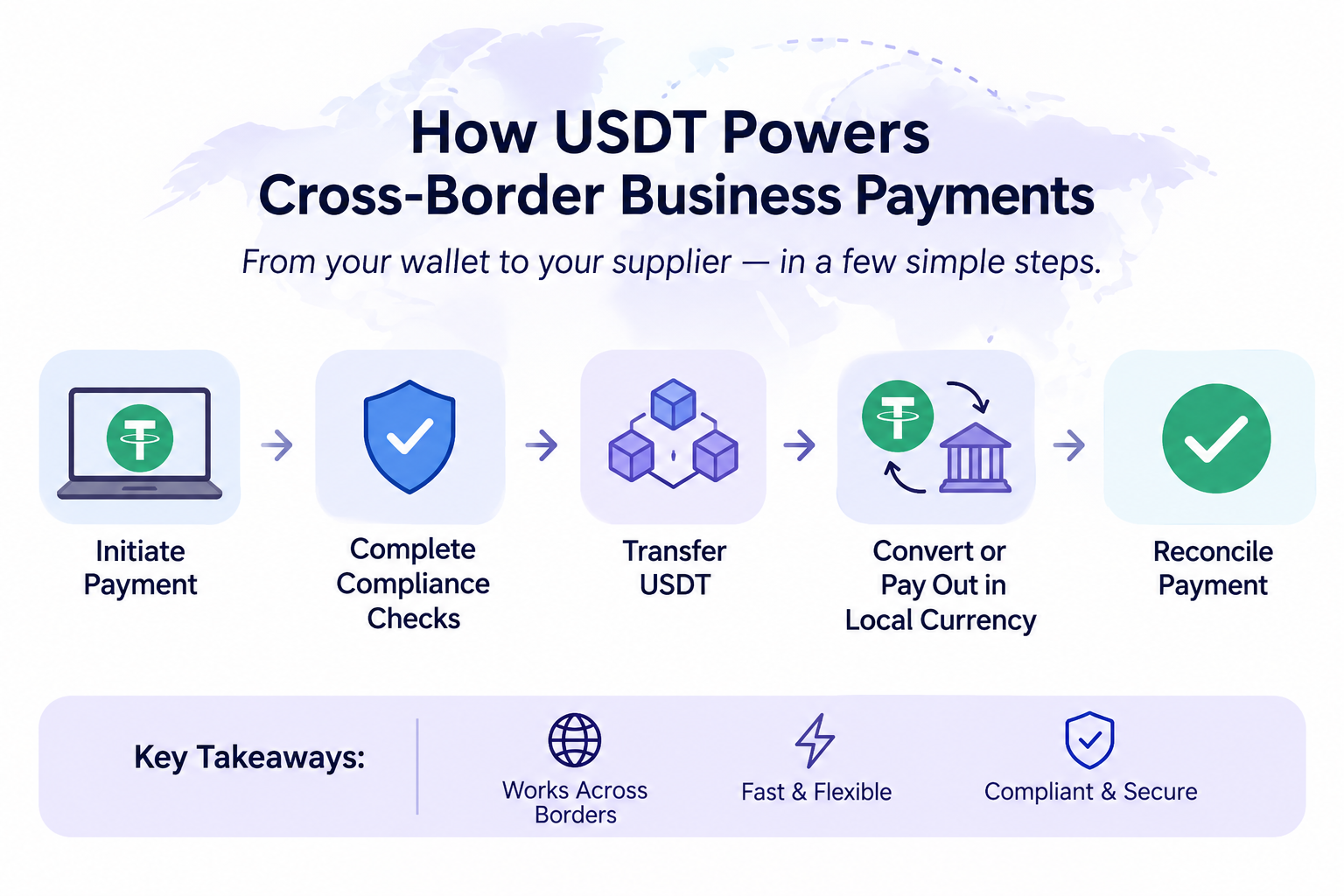
A USDT payment can involve several stages beyond a wallet-to-wallet transfer. The full process may include:
1.Initiate the payment: Identify the invoice, amount, purpose, asset, and recipient requirements.
2.Validate the beneficiary or wallet: Confirm the legal entity, wallet address, network, and destination details.
3.Complete compliance checks: Review sanctions, source-of-funds information, transaction purpose, and other applicable requirements.
4.Select the network: Use a blockchain supported by both the sender and recipient.
5.Transfer USDT: Submit the transaction and record its transaction hash.
6.Confirm the transfer: Check the blockchain status and the provider’s processing status.
7.Convert or pay out: Convert USDT or use an off-ramp if the recipient needs fiat currency.
8.Reconcile the payment: Match the transaction, invoice, fees, conversion, and final delivered amount.
A wallet transfer records the movement of USDT on a blockchain. It does not automatically deliver local fiat currency to a recipient’s bank account. If the recipient needs fiat, the process requires a supported conversion or off-ramp and a payout route for the requested currency.
Settlement time depends on more than blockchain confirmation. Provider processing, compliance review, liquidity, banking routes, recipient requirements, and operating conditions can affect completion. Guidance on cross-border transaction workflows and supplier payment methods should therefore be assessed against the specific corridor.
Blockchain confirmation is a checkpoint, not always the finish line. A transaction can be visible on-chain while the business payment remains incomplete. Operational completion occurs when the recipient receives the agreed asset or currency and the sender can reconcile the transaction hash, invoice, fees, conversion, and delivered amount.
Match USDT to collections, supplier payments, and cross-border payouts
USDT may be relevant when a business collects stablecoins, pays a supplier or partner that accepts stablecoins, or connects a stablecoin balance with a fiat settlement workflow. The strongest fit is corridor-specific.
The sender, recipient, provider, asset, network, compliance process, liquidity, and destination currency must all support the complete route. A business may use USDT as an intermediate settlement asset while the recipient ultimately receives USD, EUR, AED, CNY, or another supported currency. That outcome depends on provider, corridor, and eligibility conditions.
Common evaluation scenarios include:
•A finance manager reviewing supplier settlement
•A treasury manager comparing USD and USDT liquidity
•A payments operations manager reconciling wallet and bank movements
•A global trade manager handling a difficult payment corridor
Stablecoin use does not remove the need for beneficiary checks, source-of-funds controls, sanctions screening, invoice documentation, or appropriate tax and accounting treatment. Businesses should also confirm whether the counterparty accepts the selected asset and network.
Fuze Business is for businesses that need to send, receive, and convert fiat currencies and stablecoins from one account. Its business payments platform covers use cases such as cross-border payments, payouts, difficult trade corridors, banking-network access, and enterprise-grade compliance, subject to eligibility and supported routes.
A possible workflow is to collect USDT from a platform, convert it through a supported process, and pay a supplier in the required fiat currency. The route should be approved only after confirming recipient acceptance, network support, conversion, final payout currency, and compliance requirements.
Evaluate the real cost, speed, and liquidity of a USDT payment
A low blockchain fee does not necessarily mean a low total business-payment cost. The complete cost may include:
•Acquisition or conversion spread
•Blockchain network fee
•Provider fee
•Withdrawal or off-ramp fee
•Banking or intermediary charges
•Recipient fees
•Foreign-exchange cost
•Compliance and operational overhead
Businesses should compare the recipient’s final delivered amount and delivery time. The headline network fee alone does not show the cost of the payment. A route with a low transfer fee may still produce a higher total cost after conversion, payout, or intermediary charges.
Speed requires the same complete-route analysis. A fast on-chain confirmation does not guarantee fast supplier receipt. Conversion, screening, banking cutoffs, local payment rails, liquidity, and beneficiary processing can remain outstanding.
Liquidity also depends on the exact asset, network, amount, corridor, and payout destination. Broad USDT availability does not prove that the required route can settle efficiently.
For a specific invoice, compare the sender debit, network fee, conversion rate, provider and intermediary charges, recipient credit, and elapsed time to usable funds. Approve the route only when the expected recipient amount and total delivered cost are known.
Control network, wallet, compliance, and operational risks
The sender and recipient must use a compatible USDT network. An incorrect network or wallet address can make recovery difficult or prevent the intended recipient from receiving the funds.
Payment instructions should be independently verified before release. The business should confirm the beneficiary legal name, wallet address, network, asset, invoice reference, payment purpose, and required destination currency.
A practical control checklist includes:
•Asset and network
•Wallet address
•Amount and fees
•Beneficiary identity
•Invoice and payment purpose
•Source-of-funds information
•Conversion route
•Final currency
•Approval and reconciliation requirements
Businesses should define approval controls, segregation of duties, transaction limits, wallet allowlists where appropriate, and dual review for address changes. They should also maintain reconciliation procedures for blockchain and banking movements.
Stablecoin arrangements raise regulatory, financial-stability, monetary-sovereignty, interoperability, and user-protection considerations. These issues vary across jurisdictions, as outlined in the BIS analysis of stablecoin arrangements.
Tether’s terms state that access to issuance and redemption requires customer verification. They also state that tokens are not protected like insured bank deposits. Businesses should therefore treat USDT as a payment asset with specific operational and legal requirements.
A new supplier wallet should be verified through a trusted channel, independently approved, tested where appropriate, and added to the payment workflow before a material-value transfer. The control check should fail if the network, address, beneficiary, source of funds, payment purpose, or final payout route remains unresolved.
Compare USDT with USDC and traditional fiat payment routes
USDT and USDC are different stablecoins issued by different companies. They should not be treated as interchangeable without checking supported assets, networks, liquidity, legal treatment, and conversion routes.
Traditional fiat routes can provide familiar bank-account settlement. They may also involve correspondent institutions, foreign-exchange conversion, operating-hour constraints, fragmented data, and additional settlement steps.
Stablecoin routes can provide a blockchain-based transfer leg. However, the business still needs recipient acceptance, network compatibility, compliance controls, and an off-ramp or payout route when fiat delivery is required.
| Route | Best-fit scenario | Main dependency | Main risk to validate |
|---|---|---|---|
| USDT settlement | The recipient accepts USDT on a supported network | Network, liquidity, and recipient acceptance | Incorrect network, wallet, or final settlement expectation |
| USDC settlement | The recipient specifically accepts USDC and the route supports it | Asset support, liquidity, and conversion | Treating USDC as interchangeable with USDT |
| Bank transfer | The recipient requires direct bank-account settlement | Banking connectivity, cutoffs, and correspondent routes | Delays, intermediary charges, and fragmented payment data |
| Hybrid stablecoin-to-fiat payout | The sender uses stablecoins while the recipient needs fiat | Conversion, compliance, and local payout rails | Off-ramp or payout route unavailable for the corridor |
A unified business workflow should be evaluated on whether it supports the required fiat currencies, stablecoins, corridors, banking connectivity, conversion, compliance, and reconciliation. Fuze Business supports currencies and stablecoin workflows that include USDT, USDC, USD, EUR, and other currencies or corridors, subject to eligibility and route conditions.
For one supplier invoice, document whether the supplier accepts USDT or USDC, which network is supported, whether fiat payout is required, the conversion rate and fees, and the expected final receipt date. Select the route with the clearest path to the required currency, approved compliance process, total cost, and reconciliation record.
Use USDT where the complete payment route works for your business
USDT can be considered for cross-border business payments when the asset, blockchain network, recipient, corridor, conversion path, compliance process, and final settlement currency are compatible.
The practical question is not only whether a business can send USDT. It is whether the business can collect, convert, pay out, and reconcile funds in the way its counterparties require.
Fuze Business supports businesses in sending, receiving, and converting fiat currencies and stablecoins from one account. Its supported workflows include cross-border payments, payouts, access to difficult trade corridors, banking-network access, AED, USD, EUR, GBP, and enterprise-grade compliance, subject to eligibility and route availability.
Explore Fuze Business to collect or do payouts in USDT, convert when needed, and manage supported cross-border payment workflows from one account. Start with your corridor, recipient currency, payment volume, compliance requirements, and reconciliation needs.