
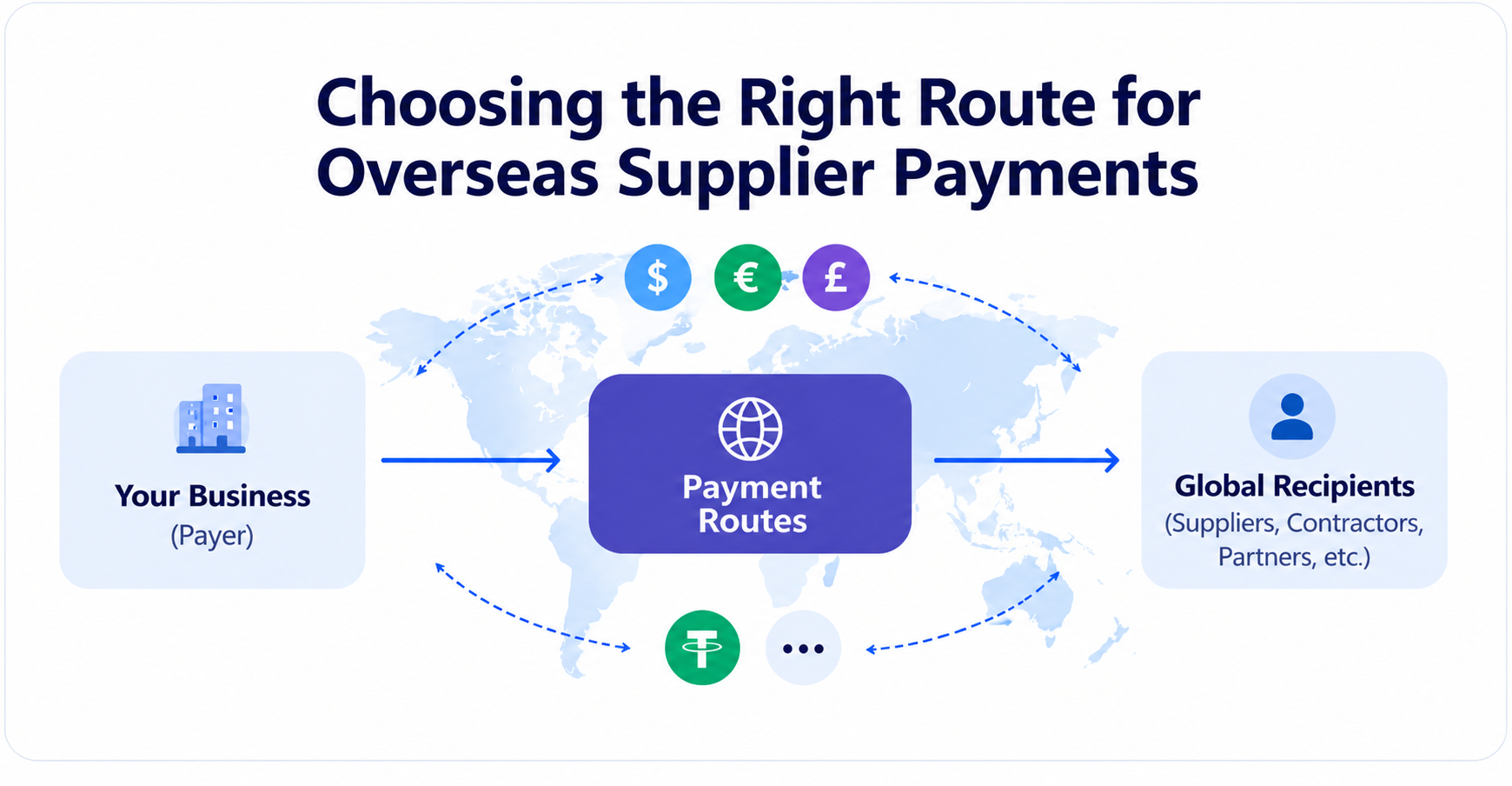
Overseas supplier payments are a route-selection decision. The right option depends on how the supplier must be paid, where the funds are going, and how quickly they must arrive.
SWIFT is a bank-to-bank messaging and correspondent-banking route. Local rails are domestic payment infrastructures accessed through local account details or payment providers. Stablecoins are blockchain-based digital assets that may support cross-border settlement and conversion.
The best route depends on the required currency, payment corridor, urgency, compliance requirements, available liquidity, transaction size, and need for bank-based documentation. Before choosing, collect the supplier’s beneficiary details, invoice currency, payment purpose, settlement date, accepted payment method, and supporting trade documents.
Gather the payment facts before choosing a route
Start by documenting the payment requirements. The route cannot be assessed accurately until the supplier, currency, corridor, and deadline are clear.
Record:
•The supplier’s legal name and beneficiary account or wallet details.
•The bank, network, or payment-provider information.
•The invoice number, payment purpose, amount, and currency.
•The required settlement date.
•The supplier’s accepted payment methods.
•Any supporting trade or compliance documents.
•The origin country, destination country, and currencies involved.
•Any intermediary or local payout requirements.
Confirm whether the supplier accepts only bank transfers, local account payments, stablecoins, or stablecoins converted into fiat currency. Currency conversion and stablecoin workflows can involve different provider, liquidity, and compliance requirements.
Also separate the visible transaction fee from the total payment cost. Include the foreign-exchange spread, intermediary charges, receiving fees, conversion costs, and possible compliance-related delays.
Define success before sending the payment. The supplier should receive the correct amount in the agreed currency by the required date. The payment should also include a usable reference and records for reconciliation.
For example, an invoice requiring CNY settlement by a fixed production date should not be routed only because the payer holds USD. The route must support the destination currency, corridor, compliance review, and delivery deadline.
Do not select a route until the destination currency, beneficiary method, payment purpose, and settlement deadline are documented.
Choose SWIFT for international bank transfers
Choose SWIFT when the supplier requires a bank transfer or the payment needs conventional bank documentation. It can also be appropriate when the destination bank is not reachable through a suitable local rail.
SWIFT’s FIN service supports interbank payment messaging and correspondent banking. Its network connects more than 11,000 organisations across more than 200 countries and territories, according to SWIFT’s correspondent banking information.
A SWIFT payment may pass through one or more correspondent institutions before reaching the beneficiary bank. The number of institutions depends on the currency, banks, and payment corridor.
SWIFT is a messaging network, not the same thing as the underlying clearing or settlement system. The complete payment route may include several banks and payment systems.
Costs and timing can depend on correspondent-bank charges, cut-off times, sanctions or compliance screening, foreign-exchange conversion, and incorrect beneficiary details. More institutions in the payment chain can also create additional points for delays or charges.
Do not compare only the sending fee. Compare the final amount received and the full expected route.
For example, SWIFT may suit a supplier that requires a USD bank transfer to its corporate account. It is less suitable if the supplier will accept only a local payout or stablecoin-based settlement.
The SWIFT route passes this check when the beneficiary bank confirms it can receive the currency. Required correspondent details, expected charges, and cut-off times should also be documented.
Choose local payment rails for domestic currency payouts
Local rails route payments through a domestic payment system or local account structure. They do not rely entirely on an international correspondent-banking chain.
This route may be useful when the supplier wants domestic currency and the payer or provider has access to local account details. The corridor must support the required payment type.
Local rails can sometimes be faster or less expensive than SWIFT. The outcome depends on the currency, provider, local infrastructure, compliance review, operating hours, limits, and account eligibility.
Local rails do not remove the need to check foreign-exchange conversion, beneficiary information, payment purpose, and settlement rules. They are a corridor-specific choice, not a universal replacement for SWIFT.
For example, a supplier may be able to receive EUR through local account details. If the provider supports that corridor, compare the local route with SWIFT by final received amount, cut-off time, and reconciliation data.
The local route passes when the provider confirms corridor availability. The beneficiary’s local details should be verified, and the expected settlement currency and amount should be clear before approval.
Choose stablecoins for flexible cross-border settlement
Stablecoins are digital assets designed to maintain a value linked to a specified asset or basket. However, the label does not guarantee stable value, universal acceptance, or identical legal treatment in every jurisdiction.
Stablecoin arrangements may support wallet-to-wallet movement. They can also connect with fiat conversion or local payout workflows. The available route depends on the asset, network, provider, corridor, liquidity, compliance process, and recipient requirements.
The BIS discussion of stablecoin arrangements highlights considerations involving regulation, financial stability, monetary sovereignty, interoperability, and user protection.
Stablecoin payments require controls that differ from ordinary bank transfers. Check the wallet address, supported network, asset acceptance, source-of-funds requirements, conversion availability, and off-ramp access.
Faster blockchain settlement does not automatically mean faster supplier receipt. The complete route may still include compliance review, conversion, local payout, and reconciliation.
Choose stablecoin rails when the complete route can convert the asset into the supplier’s required currency. The speed or corridor-access benefit should also outweigh the additional asset and compliance checks.
For example, a business holding stablecoins may use a supported stablecoin-to-fiat workflow to pay a supplier in local currency. This requires an available corridor, supported asset, sufficient liquidity, compliance approval, and a workable payout path.
Treat stablecoins as a payment route with its own operational controls. They are not a shortcut around compliance.
The route passes when the recipient’s currency is confirmed, the asset and network are supported, and the conversion or payout path is available. The business should also document the transaction from funding through supplier receipt.
Compare the three routes against the same decision criteria
Compare every route using the same criteria. Focus on the supplier’s final outcome rather than the advertised fee or technical transfer speed.
| Route | Best fit | Main checks |
|---|---|---|
| SWIFT | Supplier-mandated bank transfers and formal correspondent connectivity | Intermediary charges, cut-off times, beneficiary data, and bank reachability |
| Local rails | Supported local-currency payouts and local account details | Corridor coverage, account eligibility, limits, local compliance, and settlement rules |
| Stablecoins | Supported corridors where speed, access, or conversion flexibility matters | Asset and network support, liquidity, compliance, off-ramp access, and recipient acceptance |
Assess beneficiary acceptance, destination currency, corridor access, expected settlement time, total cost, foreign-exchange exposure, compliance requirements, payment-data quality, operational visibility, reversibility, and reconciliation effort.
SWIFT is typically strongest where bank-based settlement is required. Local rails are typically strongest where domestic account access and local-currency settlement are available. Stablecoin rails are typically strongest where supported digital-asset settlement addresses a clear speed, access, or conversion need.
The fastest-looking rail is not necessarily the fastest route to the supplier’s final usable currency. A blockchain transfer may still require conversion and local payout. A local payment may depend on account eligibility and operating hours. A SWIFT payment may involve correspondent institutions.
Build a side-by-side route table for every material supplier corridor. Mark a route as passed only when it meets the supplier’s currency and acceptance requirements, stays within the approved cost threshold, meets the settlement deadline, and produces sufficient reconciliation records.
Run a controlled first payment and reconcile the full route
Test a new provider, corridor, asset, or route with a controlled payment amount. The amount should match the supplier relationship and the business’s internal risk policy.
Use this sequence:
1.Confirm the supplier, currency, corridor, payment purpose, and beneficiary details.
2.Verify bank details or, for stablecoin workflows, the wallet address and network.
3.Approve the payment through the required internal process.
4.Record the quoted foreign-exchange rate, fees, route, and payment reference.
5.Send and track the payment.
6.Confirm the supplier received the agreed amount and currency.
7.Reconcile the payer’s debit, conversion, charges, and supplier credit.
8.Review the result and decide whether the route should become the default.
Capture the approval record, compliance documents, settlement timestamps, and final received amount. This creates an audit trail and makes route performance easier to compare.
After the first payment, compare the expected and actual supplier receipt. Also review the elapsed time, total cost, and manual work required.
A route is ready for repeat use when it passes the business’s acceptance, timing, cost, compliance, and reconciliation checks without unresolved exceptions.
Use Fuze Business to simplify supported fiat and stablecoin supplier payments
Fuze Business helps traders, importers, exporters, and finance teams manage cross-border payments through a single account. It includes cross-border payments, payouts, fiat and stablecoin conversion, banking-network access, and access to difficult trade corridors.
Fuze Business supports currencies including AED, USD, GBP,EUR, and more, subject to eligibility and corridor availability. It also positions stablecoin rails alongside banking connectivity and enterprise-grade compliance.
This can help businesses compare traditional bank routes with stablecoin-enabled workflows. A company can assess the required supplier currency, corridor, conversion path, payout method, and compliance profile before moving the workflow into production.
Actual timing depends on the corridor, compliance review, liquidity, currency, and payout conditions. Businesses should confirm pricing, eligibility, supported assets, and settlement conditions for each supplier payment.
Explore Fuze Business to assess faster global payment options for your supplier corridors and payment requirements.