
USDT is a stablecoin designed to track a reference value. It is not automatically equivalent to cash and is not universally accepted. Its treatment, availability, conversion routes, and legal requirements depend on the asset, jurisdiction, provider, counterparty, and payment corridor.
The first decision is not how to send USDT. It is what the supplier must receive. You can send USDT to a supplier-controlled wallet, or use USDT as the funding asset while the supplier receives local currency through a supported conversion and payout route.
Before starting, confirm the supplier’s agreement to the asset or payout currency, verified beneficiary details, the blockchain network if sending USDT directly, invoice and payment-purpose records, corridor availability, account eligibility, and sanctions and compliance requirements. USDT should not be used to bypass sanctions, banking restrictions, or local regulations.
This guide is for finance managers, treasury managers, payments operations managers, global trade managers, and supply chain managers evaluating USDT for overseas supplier payments.
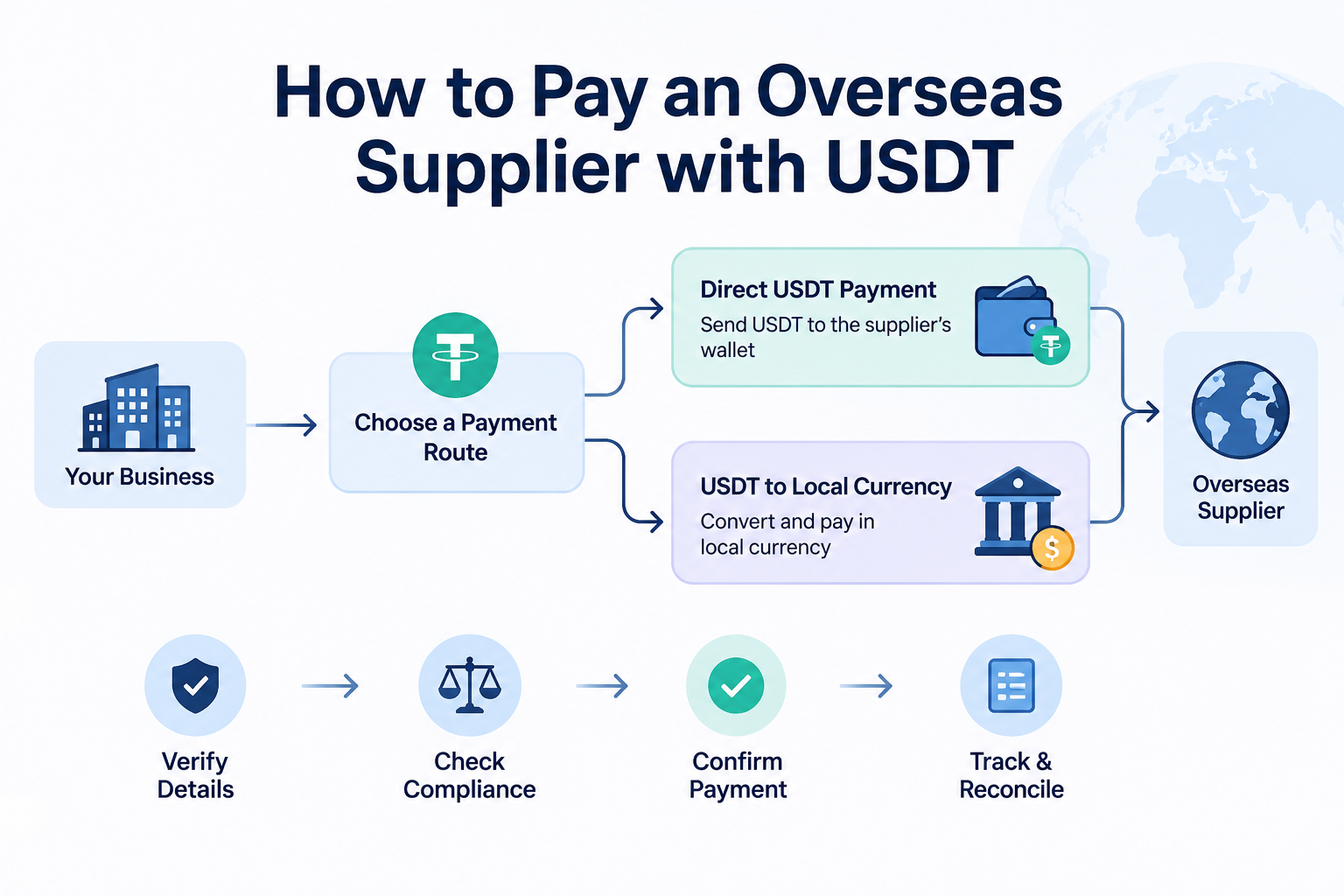
Decide whether the supplier should receive USDT or local currency
The correct settlement currency depends on the supplier’s invoice, preference, accounting policy, and local payment requirements. A supplier may accept USDT through an approved wallet workflow, or may require a bank payment in local currency.
For direct settlement, the supplier must be legally and operationally able to receive the exact USDT asset. The supplier must also support the chosen wallet type and blockchain network.
For a local-currency payout, the selected provider, currency, jurisdiction, counterparty, and corridor must support conversion and delivery to the supplier’s bank account. Fuze Business supports businesses in sending, receiving, and converting fiat currencies and stablecoins, subject to eligibility and supported routes.
Stablecoin status does not guarantee identical price behavior, legal treatment, redemption rights, or availability in every jurisdiction. Confirm the route before approving the payment.
Use one explicit target in the payment record:
•Supplier receives USDT: Use this only when the supplier accepts the exact asset, network, wallet type, and compliance process.
•Supplier receives local currency: Use this when the supplier needs a bank payout or local-currency settlement and the route supports conversion.
The payment passes this decision step when the invoice states either: “supplier receives 10,000 USDT on the agreed network” or “supplier receives the exact local-currency amount in the supplier’s bank account.”
Verify the supplier, beneficiary, and payment route before sending
Confirm the supplier’s legal name, contracting entity, invoice, beneficiary information, payment purpose, and expected settlement currency before initiating payment.
For direct USDT delivery, verify the exact wallet address, blockchain network, asset ticker, deposit rules, and wallet ownership. Confirm whether the wallet is controlled by the supplier or by an authorized payment intermediary.
A wallet address and an account identifier are not interchangeable. The payment record should identify the precise destination and payment rail. Wallet transfers require careful attention to the asset and network.
Cryptocurrency transfers can be difficult or impossible to reverse after broadcast. An incorrect address or unsupported network may create a loss or recovery problem.
Treat a wallet-address change like a bank-account change. Verify it through a trusted channel before paying. Requests to pay an unrelated agent, personal wallet, newly changed beneficiary, or third party should receive enhanced review.
U.S. persons and others subject to U.S. sanctions jurisdiction must apply sanctions requirements to virtual-currency transactions as they do to fiat transactions. OFAC states that sanctions obligations apply to virtual-currency transactions.
A payment is ready for approval only when the verified beneficiary record matches the invoice. The destination wallet or bank details should also pass an independent callback or equivalent control.
Compare the two payment workflows, costs, and settlement outcomes
Direct USDT payment and USDT-funded local-currency payout solve different supplier needs. Compare the amount the supplier receives, not only the sender’s fee.
| Workflow | Supplier receives | Information required | Cost checkpoints | Settlement confirmation | Main operational risk |
|---|---|---|---|---|---|
| USDT → USDT | USDT in a compatible wallet | Wallet destination, asset, and network | Network fee, provider fee, and funding cost | Confirmed transaction hash and supplier receipt | Wrong address, network, or unsupported wallet |
| USDT → local currency | Local currency in a bank account | Bank beneficiary, payout currency, and payment purpose | Conversion rate, spread, provider fee, bank fee, and deductions | Provider confirmation and bank settlement | Incorrect beneficiary, unsupported corridor, or unexpected net amount |
A direct USDT payment generally involves funding or holding USDT, confirming the recipient’s compatible wallet and network, authorizing the transfer, and recording the transaction hash.
A local-currency payout involves funding or holding USDT, obtaining a conversion quote, confirming local-currency payout details, authorizing the conversion and payout, and confirming bank settlement. USDT-funded payouts can settle a recipient’s required fiat currency where supported.
The effective cost can include conversion spread, provider fees, blockchain or intermediary charges, bank charges, funding costs, and recipient-side deductions. The right comparison is not fee versus fee. It is delivered amount versus delivered amount.
Select the route only after the approval record shows the source amount, conversion rate if applicable, visible fees, expected supplier receipt, and expected settlement window. Treat currency, asset, corridor, and payout-method availability as transaction-specific.
Prepare USDT funding, account approvals, and compliance records
Confirm that the business account, wallet, or payment platform is eligible for the intended asset, corridor, beneficiary, and transaction purpose.
Gather the invoice, contract or purchase order, supplier information, source-of-funds evidence where required, payment approval, and destination details. A business payment platform may also require know-your-business information and additional compliance documents before sending, receiving, or converting funds.
Stablecoin settlement changes the rail, not the obligation to document the transaction. Compliance obligations are not removed because the payment is denominated in USDT rather than fiat.
OFAC recommends a tailored, risk-based sanctions compliance program for virtual-currency businesses. Its guidance identifies management commitment, risk assessment, internal controls, testing and auditing, and training as core components.
Before execution, the approval packet should contain:
•Source asset confirmed
•Beneficiary verified
•Payment purpose documented
•Sanctions review completed
•Route supported
•Approver assigned
For recurring supplier workflows, evaluate Fuze Business where collections, conversions, and payouts need to be managed through supported business-payment routes.
Send USDT directly or convert it before the supplier payout
Choose the execution sequence based on what the supplier must receive. Do not treat direct USDT delivery and local-currency payout as interchangeable.
Direct USDT payment
1.Select USDT and the agreed blockchain network.
2.Confirm the supplier’s wallet address using a trusted source.
3.Review the amount, network fee, and required fee currency.
4.Consider a small test transfer when the amount, risk policy, and provider workflow justify it.
5.Approve and broadcast the payment.
6.Save the transaction hash.
7.Verify network confirmation and supplier receipt.
Match the asset and blockchain network on both sides before entering the amount. The ticker alone is not enough to identify the correct route. Stablecoin wallet transfers require asset and network verification.
USDT-funded local-currency payout
1.Select USDT as the source asset.
2.Choose the supplier’s required currency.
3.Confirm the conversion quote and net recipient amount.
4.Verify the supplier’s bank beneficiary details.
5.Review all fees and the expected settlement time.
6.Authorize the conversion and payout.
7.Confirm provider acceptance and bank settlement.
Do not describe the payment as complete until the provider confirms acceptance and the destination wallet or bank account shows settlement. A direct USDT payment succeeds when the transaction hash is confirmed and the supplier confirms receipt. A local-currency payout succeeds when the provider and recipient bank show the expected destination amount.
Confirm settlement and reconcile the supplier invoice
Reconciliation should connect the invoice to the source amount, asset, network or payout rail, conversion rate, fees, beneficiary, destination amount, transaction reference, settlement date, and approval record.
A blockchain confirmation does not by itself prove that a supplier’s local-currency bank payout has settled. If the supplier receives less than expected, check the conversion spread, network fees, intermediary deductions, bank charges, and beneficiary-side deductions.
If the status, recipient amount, or settlement timing differs from the approved quote, pause follow-on payments. Escalate through the provider’s resolution process.
Retain records according to the company’s accounting, tax, internal-control, and applicable compliance requirements. Reconciliation guidance includes matching transaction references, recipient amounts, rates, fees, and settlement dates.
Mark the invoice paid only when the transaction reference is stored, the recipient amount is confirmed, the settlement date is recorded, and the ledger entry agrees with the approved payment.
Manage USDT collections and supplier payouts with Fuze Business
Fuze Business enables businesses to send, receive, and convert fiat currencies and stablecoins through one account. Businesses can collect USDT and USDC through centralized wallets, convert stablecoins into supported fiat currencies, and pay suppliers across supported corridors.
Before initiating payments, verify supplier acceptance, corridor availability, conversion costs, beneficiary details, compliance requirements, and expected settlement amounts. Confirm settlement and reconcile each payment against the invoice.
Explore Fuze Business to assess supported routes and manage cross-border supplier payments.