
Stablecoins are cryptocurrencies designed to maintain a relatively stable value. USDC is one example. Circle describes USDC as a fully reserved stablecoin designed to maintain equivalence to the U.S. dollar, but stablecoins do not all have identical reserves, redemption rights, supported networks, or risk profiles. You can review USDC’s design and reserve information before using it.
This guide is for beginners moving stablecoins between exchanges, software wallets, hardware wallets, and business payment platforms. A stablecoin transfer is a blockchain transaction involving a token designed to track a reference value, usually a fiat currency.
A wallet controls keys and signs transactions. The assets do not sit inside your phone or hardware device. Instead, the asset movement is recorded on a blockchain. A wallet is an application or device interface that connects to a blockchain or custodial platform to execute transactions and manage digital assets. You can review this wallet definition and terminology.
Before starting, confirm the stablecoin, sending and receiving network, recipient address, transfer amount, network fee, sender-wallet access, and a block explorer for the selected chain. On-chain transfers are generally irreversible. Verify the address and network before approving the transaction.
Network availability, fee rules, confirmation requirements, and exchange deposit policies vary by provider and blockchain.
Understand the stablecoin transfer model before sending
A stablecoin can exist on multiple blockchain networks. The same ticker can therefore represent different network-specific assets. The sender and recipient must use a compatible chain.
For example, a USDC transfer labeled Ethereum is not interchangeable with USDC labeled Solana, Base, or another supported network. The ticker is not enough to identify the correct route. Check the asset and network as a pair using the provider’s supported-chain documentation.
Wallet type also affects the workflow:
•A software wallet uses an application to select the asset, network, recipient, amount, and fee.
•A hardware wallet adds a separate signing device where you review details and physically approve the transaction.
•An exchange account is custodial. The exchange processes the withdrawal and applies its own rules.
•A business payment platform may combine stablecoin funding, conversion, and settlement.
On Ethereum, token transfers require gas. Gas is generally paid in the network’s native currency unless the wallet or network supports another fee method. Review how Ethereum gas works before sending.
Cryptocurrency payments typically are not reversible. A wrong address or unsupported network can cause permanent loss or delayed recovery. The foundation is clear when you can identify the asset, chain, wallet type, and fee currency before opening the send screen.
Choose the wallet, network, and transfer route
Choose the route based on where the funds are now and where they need to arrive. The sending and receiving platforms must support the same asset-network pair for a standard direct transfer.
| Attribute | Software wallet | Hardware wallet | Exchange account | Business payment platform |
|---|---|---|---|---|
| Custody model | User controls the signing key | User controls the signing key, with separate device approval | Platform controls the withdrawal process | Platform manages an approved payment workflow |
| Main review point | Check the app and block explorer | Verify the destination on the trusted device display | Check withdrawal and deposit rules | Confirm corridors, currencies, fees, and compliance requirements |
| Fee handling | Keep the required fee asset available | Keep the required fee asset available | Review exchange withdrawal charges | Review the platform quote and applicable fees |
| Confirmation method | Approve in the wallet application | Physically approve on the device | Complete platform security checks | Follow the platform’s approval and settlement process |
For a USDC withdrawal from an exchange to a wallet, the exchange’s sending network must match the wallet’s receiving network. Follow the wallet’s token-sending workflow and the hardware wallet’s transaction review process.
The receiving platform may support only selected chains for deposits. Check its deposit screen and network instructions rather than relying on the token ticker. Network fees also fluctuate with network conditions and transaction type. The fee shown at confirmation is the decision point for the transfer.
The route is valid when both platforms display the same asset-network pair and the recipient platform explicitly accepts deposits on that network. For a broader overview of international payment methods, settlement processes, and payment requirements, read our guide to cross-border payments.
Prepare the sender, recipient, and fee balance
Obtain the recipient address from the receiving wallet or platform’s current deposit screen. Do not rely on an old message, saved screenshot, or copied record.
Confirm these fields before sending:
•Asset confirmed.
•Network confirmed.
•Recipient address verified.
•Amount confirmed.
•Fee balance available.
•Recipient platform accepts the route.
•Test amount decided.
Self-custody wallets usually require enough of the network-native asset to pay the fee. For example, a token transfer on Ethereum generally requires the relevant native fee asset. Confirm the required balance in the wallet before starting.
For exchange deposits, review the minimum deposit amount, memo or tag requirements where applicable, supported networks, and pending-credit rules. Exchange guidance on send and receive troubleshooting can help identify platform-specific requirements.
For a hardware wallet, verify the receive address on the device’s trusted display, not only on the connected computer or phone. The hardware-wallet security guidance also supports using a small test transaction to reduce the risk of a large operational error.
A first-time transfer can begin with a small test amount. Preparation is complete when every checklist item has a recorded pass and no field depends on an unverified copy-paste value.
Send, sign, and broadcast the stablecoin transfer
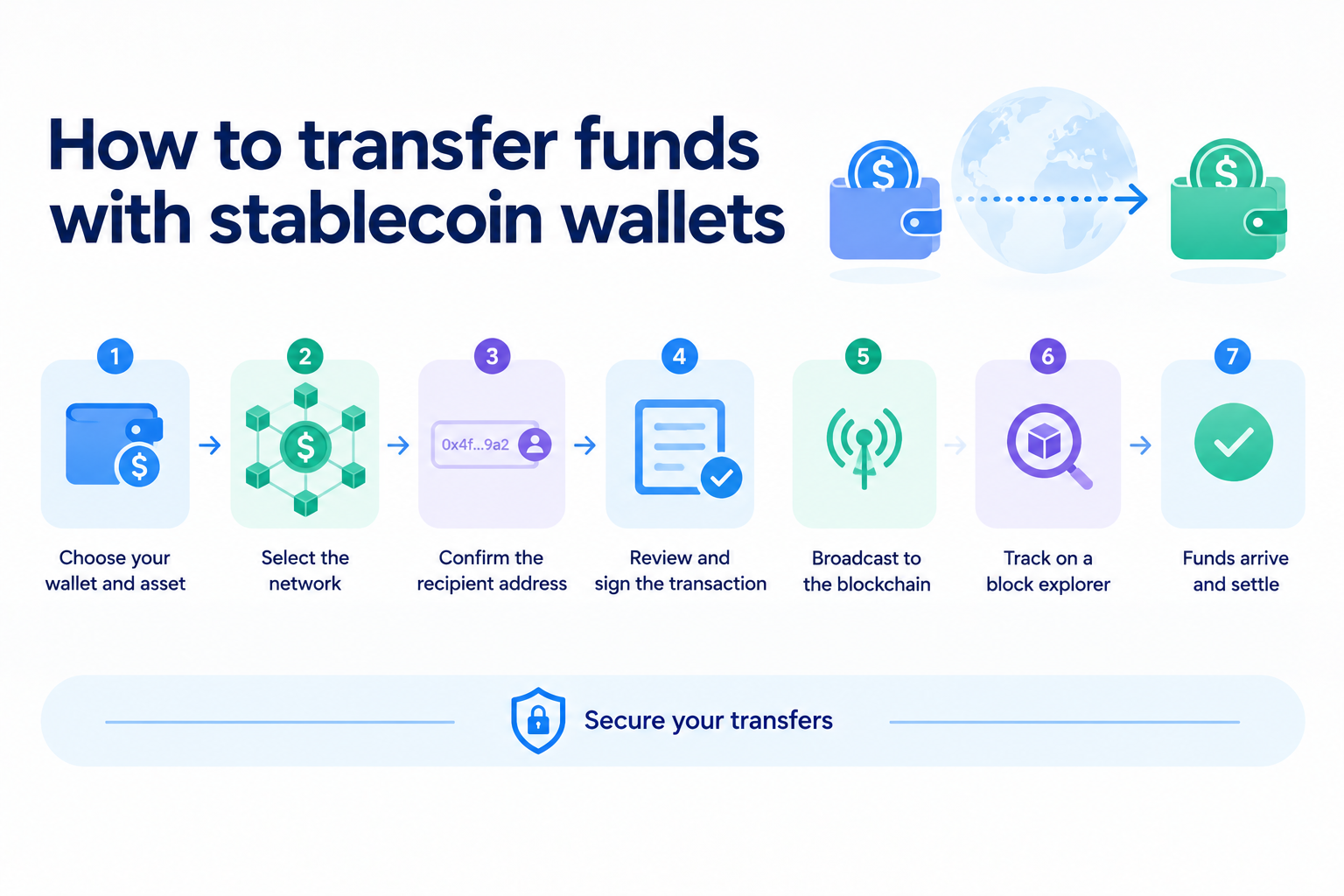
A typical transfer follows this sequence:
1.Select: Open the send function and choose the stablecoin and network.
2.Enter: Add the verified recipient address and transfer amount.
3.Review: Check the asset, network, address, amount, and estimated fee.
4.Sign: Approve the transaction in the software wallet or on the hardware device.
5.Broadcast: Submit the signed transaction to the blockchain.
6.Track: Save the transaction hash and monitor its status.
The standard software-wallet send process usually displays the fee before confirmation. A hardware-wallet workflow adds device connection, on-device review, and physical approval. Compare the displayed recipient address and network with the approved payment instruction before signing.
The final confirmation screen is the last practical opportunity to stop an incorrect on-chain transfer. Never approve a transaction when the address, asset, network, amount, or fee differs from the intended instruction.
A submitted transaction may remain pending while it awaits inclusion and confirmations. Treat submitted, pending, and confirmed as different states. On Ethereum, the fee depends on computational usage and fee conditions, and a fee can still be charged if a transaction fails. Review Ethereum’s gas guidance for more context.
The send step worked when the wallet returns a transaction hash or transaction record and the status eventually changes from submitted or pending to confirmed.
Verify settlement and troubleshoot common failures
Use the transaction hash in the block explorer for the selected network. Confirm the destination address, token contract or asset, network, amount, and confirmation status.
A receiving platform may not credit funds immediately after on-chain confirmation. It may require additional confirmations, internal review, identity checks, or a supported deposit format.
| Status | What to check |
|---|---|
| Pending | Inspect confirmations and network status. Do not duplicate the payment. |
| Confirmed but not credited | Check the recipient network, deposit requirements, and platform review status. |
| Wrong address | Contact the recipient or platform immediately, without assuming recovery is possible. |
| Insufficient fee balance | Fund the required fee asset only after confirming the correct network. |
If a transaction is pending, check both the wallet and block explorer before taking action. Some wallets offer speed-up or cancellation options for eligible transactions. Do not submit another payment simply because the first one is taking time. Review guidance on pending cryptocurrency transactions.
If a transfer is marked complete but remains missing, compare the recipient address and network with the intended details. Then provide the receiving platform with the transaction hash, asset, network, amount, and timestamp.
A wrong-network transfer may be unrecoverable by the exchange or recipient platform. Do not assume customer support can reverse it. Verification is complete when the on-chain record and the receiving platform’s balance or support response agree.
Secure repeat transfers and business operations
Use operational controls when transfers become routine or involve business funds. Never share a seed phrase or private key with a support agent, recipient, exchange, or recovery service. Anyone with that recovery material may be able to control the wallet.
A reliable control stack is: verify the beneficiary, verify the network, test the route, limit the amount, require approval, record the hash, and reconcile the receipt.
For new beneficiaries, verify the address through an independent channel. Consider address-book controls, approval limits, test transfers, and dual review for larger payments. Hardware-wallet users should verify transaction details on the device’s trusted display.
Keep a transfer record containing the business purpose, approved beneficiary, asset, network, amount, fee, transaction hash, and settlement confirmation. This record supports reconciliation and gives another authorized team member a complete audit trail.
Cryptocurrency transfers generally do not provide the same dispute and reversal protections as card payments. Prevention and operational controls are therefore central to security. Ignore unsolicited recovery offers and never pay someone who requests seed phrases, private keys, or upfront fees to recover funds. The FTC warns about cryptocurrency scams and recovery fraud.
A finance team’s first payment to a new supplier can require beneficiary verification, a small test transfer, second-person approval, and reconciliation against the supplier’s expected receipt. The workflow is operationally secure when another authorized team member can reproduce the transfer audit trail without requesting private keys or seed phrases. For more guidance on managing international supplier payments, payment workflows, and cross-border transfers, explore our guide to paying suppliers globally.
Use Fuze Business for faster global payments
Safe stablecoin transfers depend on matching the asset and network, verifying the beneficiary, funding fees, confirming the transaction, and reconciling settlement. For businesses, the payment route must also support the required currencies, corridors, controls, and compliance processes.
Fuze Business helps simplify global cross-border payments through a unified platform for sending, receiving, and converting funds. It is designed for cross-border transactions, stablecoin conversion, access to difficult trade corridors, AED, USD, GBP, EUR, banking-network connectivity, faster settlement, and enterprise-grade compliance.
Fuze Business uses stablecoin rails rather than relying only on traditional payment processes. This positions it as a faster and quicker option for global payments, without promising a universal settlement time. Explore Fuze Business to evaluate stablecoin-enabled workflows for finance teams, global trade companies, and supply-chain teams.