
Finance managers, global trade companies, and supply chain managers approve or execute domestic and cross-border payments every day. That makes payment processes a frequent target for fraud.
A wire transfer scam is a fraudulent attempt to persuade an individual or business to send funds to an account controlled by a criminal. Business email compromise (BEC) is a closely related pattern. Criminals spoof or compromise trusted communication channels to redirect payments.
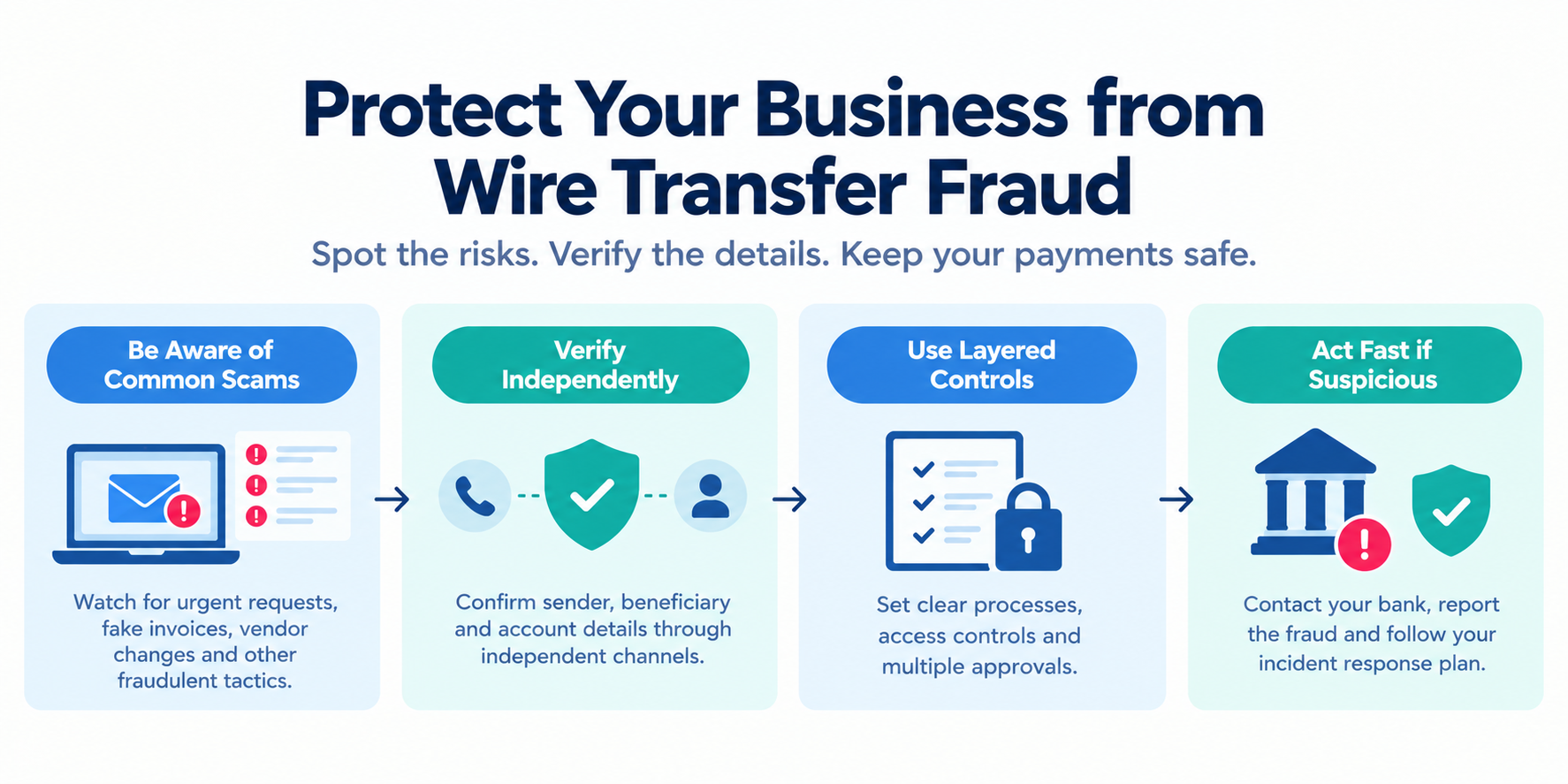
The safest operating principle is simple: pause, verify payment details through an independent channel, and escalate suspicious requests before funds move. This guidance applies to email, invoices, vendor-bank-detail changes, phone calls, messaging apps, and video-meeting instructions. For a broader overview of international payment methods, settlement, and currency considerations, read our guide to cross-border payments.
Before using this process, your organization should have a documented payment-approval policy, an independently sourced contact directory, access to its bank or payment provider, and a named escalation owner.
Identify common wire transfer scams targeting businesses
A wire transfer scam uses a deceptive request to make a person or business send funds to the wrong recipient. BEC, also called email account compromise, often uses messages that appear to come from a known source to request payments or payment-detail changes.
The FBI describes BEC as one of the most financially damaging online crimes. Losses can reach thousands or hundreds of thousands of dollars in a single incident.
Common patterns include:
•Executive impersonation: A criminal appears to be a senior executive and requests an urgent or confidential transfer.
•Vendor-bank-detail change: A supplier appears to request payment to a new account.
•Fake invoice: An invoice uses a real company name but changes the beneficiary, amount, or payment instructions.
•Real-estate wire fraud: A criminal redirects a legitimate property or title-company payment.
•Payroll or direct-deposit diversion: A request attempts to move an employee’s wages to another account.
•Compromised mailbox: A criminal uses access to a real mailbox or email thread.
•Deepfake or virtual-meeting instruction: A criminal uses a video meeting or manipulated identity to support a payment request.
Criminals may use spoofed domains, spear phishing, malware, compromised email accounts, or altered invoices and wiring instructions. A scam can also begin through a phone call, text message, or virtual meeting platform. A familiar communication channel does not prove that a request is authentic.
For example, a supplier’s familiar email thread requests payment to a new account. It says the change is confidential and must be completed that day. Treat the request as unverified until you confirm it independently.
Classify each request by sender identity, payment purpose, destination, communication channel, and any changed account or process.
Spot the red flags before approving a wire transfer
The strongest warning signs are urgency, secrecy, pressure, and changes that bypass normal approval procedures. A familiar name is not proof that a payment instruction is genuine.
Check for these signals before approving a transfer:
•Urgency or pressure to act immediately.
•Secrecy or instructions not to involve colleagues.
•Changed bank details, beneficiary names, payment locations, invoices, or payment methods.
•Unusual amounts, currencies, destinations, or payment timing.
•Slightly altered email addresses, URLs, domains, spelling, or display names.
•Unexpected links, attachments, password-reset requests, or credential requests.
•Pressure to skip normal approvals or controls.
•A refusal to confirm the request through a known phone number or normal video channel.
•A new callback number supplied in the suspicious message.
•An unexpected demand for payment by wire, cryptocurrency, or gift card.
A display name may say “CFO,” while the actual sender domain contains an extra character. If the message also requests a confidential transfer outside the approval workflow, stop and escalate.
Fail the payment request if any red flag remains unexplained. Also stop if the destination cannot be confirmed using contact information already held in company records.
Verify the sender, beneficiary, and account details independently
Do not rely only on the email, text, invoice, or message containing payment instructions. Independent verification protects payment changes when a mailbox, thread, or communication channel may be compromised.
Use a contact method that existed before the suspicious request. This may include a trusted phone number, stored vendor contact, vendor master record, contract, or in-person confirmation. Do not use a phone number or link supplied in the suspicious message.
Follow this sequence:
1.Pause the payment and preserve the original request.
2.Contact the intended sender through independently sourced contact information.
3.Confirm the recipient’s legal name and bank or payment details.
4.Confirm the currency, amount, invoice reference, and payment purpose.
5.Ask whether any account, beneficiary, or payment process changed.
6.Compare the information with the contract and approved vendor records.
7.Use a second communication channel for significant transactions.
8.Require a second approver for high-value or unusual payments.
9.Record who confirmed the request, when they confirmed it, and what they verified.
10.Release the payment only after all required checks are complete.
A suitable verification script is: “We received a request to change the payment destination. We will not process it until we confirm the change using the contact details already on file.”
Forwarding the email or replying to the existing thread is not independent verification. The mailbox or thread may already be compromised.
Verification works when the intended sender confirms the exact beneficiary and payment details independently. The second approver should record that confirmation before release.
Secure the payment process with layered controls
A secure payment process prevents one compromised mailbox or employee from requesting, approving, and releasing a material payment. Layered controls reduce payment-diversion risk by separating responsibilities and adding verification steps.
Build the control environment around these measures:
•Document procedures for purchases, invoices, account changes, and wire transfers.
•Train employees to recognize impersonation, urgency, phishing, malware, and unusual requests.
•Enable multifactor authentication on email and accounts supporting financial operations.
•Limit access to payment systems.
•Separate request, approval, and release responsibilities where practical.
•Maintain an accurate vendor and beneficiary directory.
•Use a controlled process for changing bank details.
•Review payment activity for unusual amounts, destinations, timing, or behavior.
•Keep sensitive financial and personnel information off public channels where possible.
•Escalate suspicious requests to a named internal owner.
Adopt a clear policy: No payment-detail change becomes effective from email alone.
For example, a vendor-detail change is logged and independently confirmed. A second employee reviews it, then compares the old and new details with the contract and approved vendor record. The payment is released only after those steps are complete.
The control environment passes when a single compromised mailbox or employee cannot independently request, approve, and release a material payment.
Respond immediately if a fraudulent wire was sent or suspected
Contact the financial institution immediately if a transfer may be fraudulent. Ask the bank to contact the receiving institution and attempt to stop or recover the funds.
Then:
•Request an urgent recall, freeze, or receiving-bank contact.
•Report the business email compromise or related fraud to the FBI’s Internet Crime Complaint Center (IC3).
•Preserve emails, headers, invoices, account details, call records, payment confirmations, screenshots, and access logs.
•Notify incident-response, information-security, legal, and executive contacts.
•Change credentials for potentially compromised accounts.
•Review email forwarding rules and multifactor-authentication settings.
•Investigate possible malware or unauthorized access.
•Document the incident timeline and all actions taken.
Rapid reporting may create an opportunity for intervention, but recovery is not guaranteed. The outcome depends on the circumstances and how quickly the funds move.
Do not wait for certainty before contacting the bank. Within minutes of discovering the fraud, provide the transfer reference and recipient details. Ask for an urgent recall or freeze, then file the IC3 report.
This response is complete when the bank, IC3, internal incident owner, and relevant security contacts have been notified. You should also have a written timeline and evidence package.
How Fuze Business helps with faster, more controlled global payments
Fuze Business helps businesses send, receive, convert, and track cross-border payments through banking networks and stablecoin rails. It offers transaction monitoring, transparent pricing, and reconciliation to improve payment visibility and control.
Businesses can review exchange rates using the currency converter before making payments. While faster settlement and compliance controls support efficient operations, businesses should still verify beneficiaries and follow internal approval procedures to prevent fraud.
Explore Fuze Business to simplify global payments across supported corridors.