
USD payment trends are best understood through several benchmarks. These include currency share in cross-border payment flows, reserve and trade usage, regional variation, settlement speed, cost, transparency, and access.
The dollar remains the default operating currency for much international business. However, businesses are adapting the infrastructure around USD payments through multi-currency accounts, stablecoin rails, and unified payment operations. Fuze Business is one relevant example of a platform designed to help businesses open a USD account quickly and manage fiat and stablecoin movement from one account.
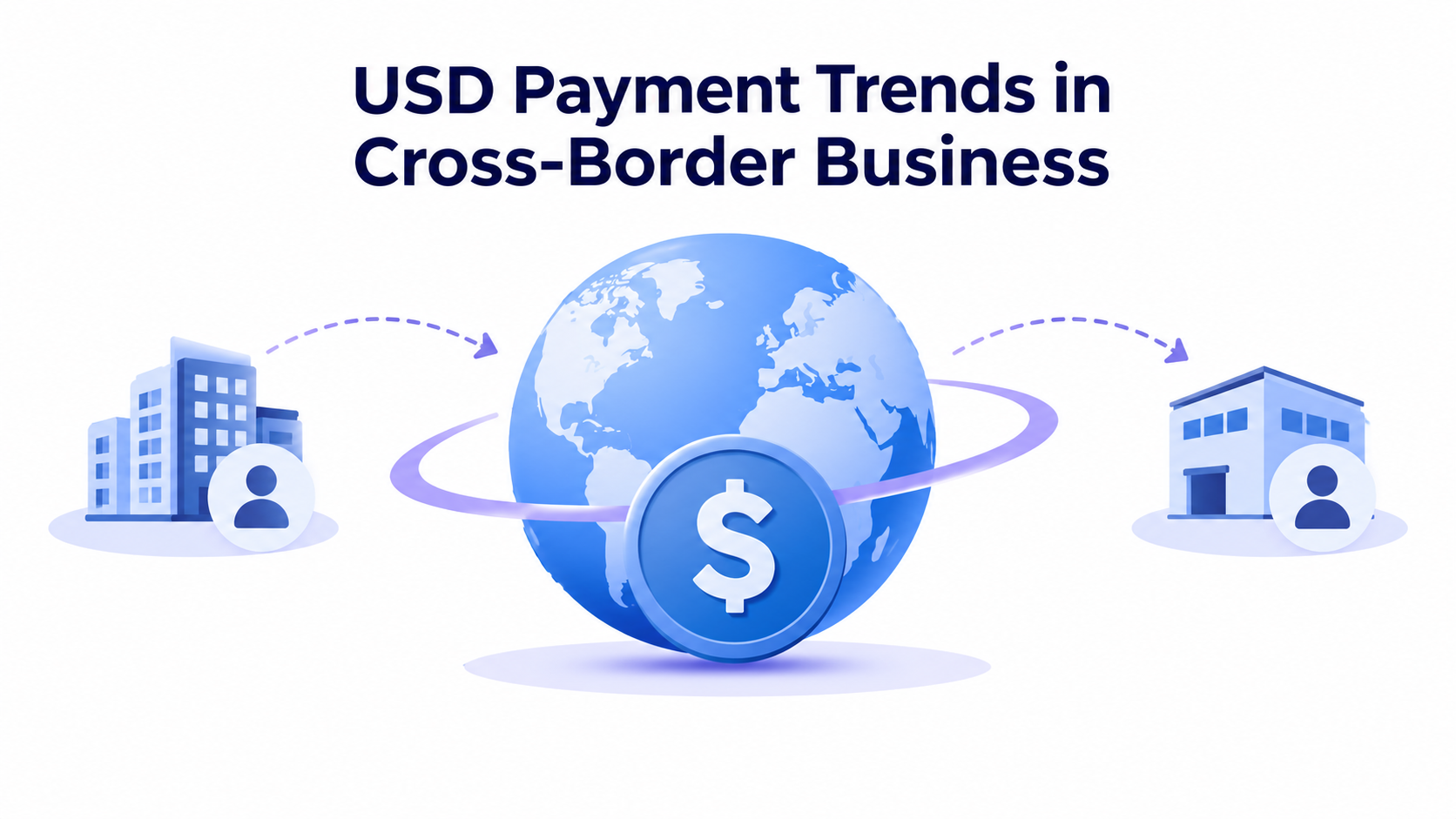
What USD payment trends actually measure in cross-border business
USD payment trends show how businesses use the dollar across currencies, corridors, counterparties, and settlement rails. This includes international collections, supplier payments, trade settlement, treasury activity, and currency conversion.
Currency usage and payment-rail usage are different measures. A payment can be denominated or settled in USD while moving through correspondent banking, a banking network, or a stablecoin-linked route.
The IMF’s 2025 research separates financial-institution payments from customer payments. In 2024, the USD represented 53.4% of financial-institution payment value and 55.1% of customer payment value, according to IMF cross-border payment research.
The same research notes that many USD-denominated payments occur between third-country originators and beneficiaries. This means the United States is not necessarily a party to the payment.
A manufacturer in one non-US country can invoice a buyer in another non-US country in USD. It may fund the payment from a local-currency balance while the supplier receives USD or another local currency.
That transaction is USD-relevant even though neither company is based in the United States. It also shows why payment-message data, payment-value data, reserve data, and trade-invoice data should not be treated as interchangeable benchmarks.
The US dollar leads global cross-border payment activity
The USD remains the leading benchmark for cross-border payment activity. In the IMF’s 2024 dataset, it represented 53.4% of financial-institution payment value and 55.1% of customer payment value.
Between 2021 and 2024, the USD share increased by 2.5 percentage points for financial-institution payments. Its share of customer payments was broadly unchanged during the same period, based on the IMF payment dataset.
The USD also leads across several international-system indicators. These include trade invoicing, foreign-exchange reserves, international bank claims, international bonds, foreign-exchange turnover, and global payment activity, as reported in the IMF External Sector Report.
IMF COFER data reported in March 2026 showed the USD at 56.77% of allocated global official foreign-exchange reserves in 2025 Q4. The euro represented 20.25%, while the renminbi represented 1.95%, according to IMF reserve data.
These figures support a durable-dollar narrative. They do not mean every corridor, industry, or business category uses USD in the same way.
The USD is still the default benchmark for global payment activity. The operating model around it is changing.
Global payments remain USD-led, with growing regional currency diversity
The USD remains the largest-use currency, but other currencies are becoming more integrated into international payments. The renminbi is one example, although its international use is growing from a relatively low base.
In the 2024 IMF dataset, the CNY represented 3.7% of financial-institution payment value and 1.4% of customer payment value. Its financial-institution share increased by 1.5 percentage points between 2021 and 2024, according to IMF cross-border payment findings.
The euro remains particularly important in European payment activity. Other currencies can also matter more in specific regional corridors.
Reserve diversification does not automatically indicate a rapid shift in operating-currency usage. The IMF reports gradual changes in reserve composition alongside continued USD leadership, as outlined in its reserve-system analysis.
Businesses should therefore benchmark USD usage by:
•Corridor and supplier geography
•Invoice currency and settlement currency
•Counterparty requirements
•Local banking access
•Conversion and liquidity needs
A company paying suppliers in China, collecting in Europe, and selling into the United States may need USD, EUR, and CNY workflows. The USD can remain its primary treasury or invoice currency while other currencies support specific operations.
Cross-border payment infrastructure matters as much as currency choice
The next question for businesses is not only which currency to use. It is also which route can settle the payment reliably.
The Financial Stability Board reports progress in wholesale payment speed and remittance speed. However, improvements in cost and end-user experience remain limited overall, according to its 2025 progress report.
The FSB continues to identify challenges across speed, cost, transparency, and access. This makes the payment rail and account structure material to daily business operations.
Stablecoins are part of this infrastructure discussion. The BIS states that stablecoin use remains modest compared with bank deposits. It also notes that stablecoin performance as a cross-border payment instrument can vary after fees, spreads, and on- and off-ramp costs are included, as explained in its 2026 Annual Economic Report.
The BIS reported stablecoin market capitalization of approximately $320 billion at the end of May 2026. It estimated 2025 annual stablecoin transaction volume at $28 trillion, while noting that this includes activity that may not represent business payment settlement.
Stablecoins should therefore be evaluated as an infrastructure option, not proof that bank-based USD payments are being replaced. They may improve access or settlement options in some corridors, but they do not remove compliance, liquidity, pricing, or conversion considerations.
A business comparing routes should assess total cost, compliance requirements, settlement timing, recipient requirements, and reconciliation. Headline transaction speed alone is not enough.
How finance teams should benchmark USD payment performance
Finance teams should track USD payment performance across six dimensions: corridor coverage, account access, settlement speed, total cost, payment-status visibility, and reconciliation effort.
•Access: Measure account availability, onboarding time, and corridor coverage. This determines whether a payment can be initiated.
•Speed: Measure the time from payment initiation to usable funds for the recipient. This links payment performance to working capital.
•Cost: Include FX spreads, payment fees, intermediary charges, on- and off-ramp costs, and operational handling time.
•Visibility: Track payment status, exceptions, and investigation requirements. This reduces uncertainty for finance teams and counterparties.
•Reconciliation: Measure how easily teams can match collections, payouts, invoices, and balances.
•Reliability: Review whether the route consistently reaches the intended recipient across the relevant corridor.
This framework turns broad USD payment trends into practical treasury and payments-operations questions.
A USD payment option that is inexpensive but cannot reliably reach a supplier may perform poorly. The same applies when it provides limited status visibility or requires manual reconciliation across disconnected accounts and wallets.
What a USD account should support beyond holding dollars
A USD account can be more than a place to hold dollar balances. Businesses operating across borders may need to collect payments, convert currencies, pay suppliers, access difficult trade corridors, and manage different settlement routes from one place.
Fuze Business brings together these capabilities through banking-network and stablecoin rails. Depending on corridor availability and business eligibility, businesses can collect and hold USD, convert currencies, pay overseas suppliers, and access supported trade corridors. They can also track payments and collections and reconcile transactions in one place.
USD remains important to international business, but the value of an account depends on how effectively it supports day-to-day payment operations. Businesses should evaluate the full payment route, including total cost, settlement reliability, compliance, recipient requirements, and reconciliation.
With Fuze Business, businesses can open a USD account in days, not months, subject to eligibility and onboarding requirements, and manage global money movement from one place.
Looking to simplify your global payments? Explore Fuze Business to see how you can collect, convert, and pay across borders from one platform.