
People familiar with digital payments may still find blockchain wallets unfamiliar. A stablecoin wallet is best understood as an access layer for stablecoin balances. It does not store coins in the same way a physical wallet stores cash.
Stablecoins are digital assets designed to maintain a stable value against a currency, commodity, crypto asset, or another reference. That stability is not guaranteed. Wallets can be custodial, where a provider controls or helps manage private keys, or self-custody, where the user controls them.
Stablecoin wallets can support digital-dollar holdings, international transfers, payment collection, currency conversion, and business settlement. The practical result depends on the corridor, currency, compliance process, liquidity, and transaction conditions.
What is a stablecoin wallet?
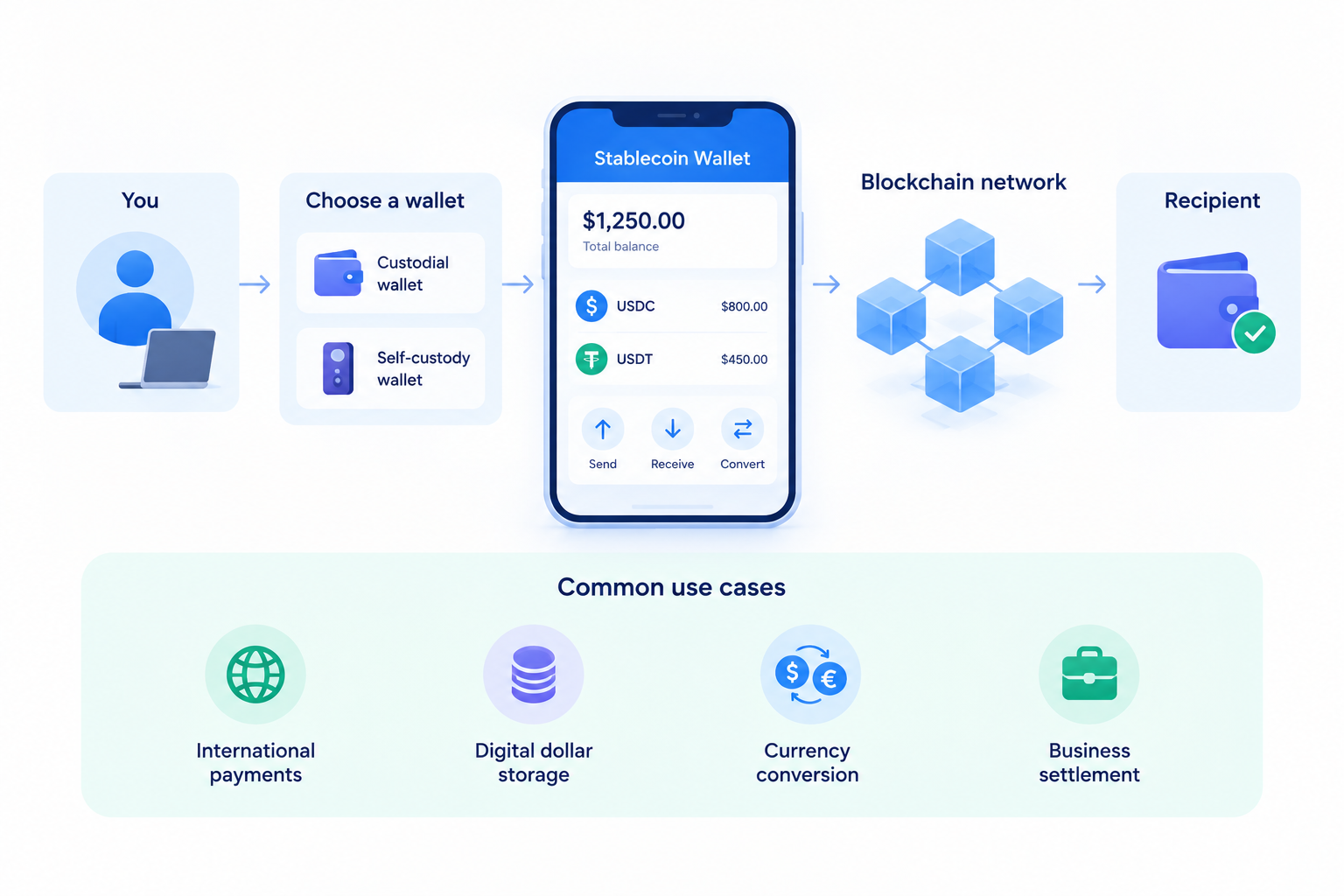
A stablecoin wallet is the tool that lets you access and move stablecoins. It may be an application, account, device, or service that supports stablecoins recorded on a blockchain or another payment system.
A wallet generally stores private keys or provides access to them. The stablecoin balance itself remains recorded on the relevant blockchain or ledger, as described in research on digital money.
A wallet address identifies where stablecoins can be sent. A private key, signing device, or provider-controlled authorization method permits a transaction. Losing access to the authorization method can prevent the user from moving funds.
A stablecoin wallet is not automatically a bank account or deposit account. It also does not guarantee that a stablecoin will always equal its target value.
Wallet functionality varies by:
•Supported blockchain networks and token standards
•Supported assets and currencies
•Custody model and recovery process
•Transaction limits and fees
•Compliance and identity requirements
•Conversion and withdrawal options
Before sending funds, identify the wallet, stablecoin, blockchain or payment network, recipient address, and authorization method.
Compare custodial and self-custody stablecoin wallets
The main difference is who controls the private keys and who handles recovery. A custodial wallet relies on a provider, while a self-custody wallet places more control and responsibility with the user.
| Attribute | Custodial wallet | Self-custody wallet |
|---|---|---|
| Custody of keys | Provider controls or manages the keys | User controls the keys or recovery phrase |
| Recovery process | Provider may offer account recovery | User must protect and recover the phrase or key |
| Transaction approval | Provider infrastructure may authorize or process transfers | User directly approves transactions |
| User responsibility | Lower operational responsibility, but more provider dependence | Higher responsibility for security and recovery |
| Best-fit scenario | Users seeking simpler onboarding and managed access | Users seeking direct control over signing and transfers |
Custodial wallets may simplify onboarding, recovery, compliance screening, and conversions. They can also create dependence on account access, provider operations, and provider policies.
Self-custody wallets offer greater direct control. However, the user must protect the recovery phrase, prevent unauthorized access, and understand transaction approvals. Security guidance for blockchain wallets highlights the importance of protecting these access credentials.
Hardware wallets are a type of self-custody setup. They store key material on a dedicated device. Software wallets usually operate through mobile, desktop, or browser applications.
Neither model removes the need to verify the blockchain, token, recipient address, fees, and transaction rules. Before choosing a wallet, answer two questions:
1.Who can authorize a transfer?
2.What happens if access credentials or the recovery phrase are lost?
How stablecoins maintain a target value
Stablecoins use different designs to target a stable value. The design affects reserves, collateral, redemption, liquidity, and risk.
| Stablecoin type | How it targets value | Main considerations |
|---|---|---|
| Fiat-backed | Uses reserve assets, issuance, redemption, and market mechanisms | Reserve quality, redemption access, issuer risk, and liquidity |
| Crypto-collateralized | Uses crypto assets as collateral | Collateral volatility, over-collateralization, and liquidation rules |
| Commodity-backed | References assets such as precious metals or other commodities | Commodity exposure, custody, valuation, and market liquidity |
| Algorithmic | Uses protocols or algorithms to manage supply and demand | Design risk, market confidence, and limited or absent reserves |
A fiat-backed stablecoin may reference the U.S. dollar or euro. Its issuer may use reserves and redemption arrangements to support the target value. A crypto-collateralized stablecoin may require more collateral because its underlying assets can fluctuate.
Commodity-backed stablecoins create exposure to the referenced commodity and its custody arrangements. Algorithmic stablecoins rely more heavily on supply-management mechanisms and market incentives.
The term “peg” describes the intended relationship between a stablecoin’s market value and its reference asset. It is not an absolute promise of a fixed price everywhere. Stablecoin analysis emphasizes the importance of design, reserves, and market conditions.
A stablecoin can trade above or below its target value. The result may depend on reserve quality, redemption rules, liquidity, governance, market conditions, and access to the relevant network or issuer. For a token intended to track the U.S. dollar, check its reserves, redemption process, eligibility rules, fees, and conditions for trading away from $1.
Stablecoin wallet use cases and potential benefits
Stablecoin wallets support both personal and business payment workflows. Their usefulness depends on whether the complete route supports the required asset, currency, recipient, and compliance process.
Common uses include:
•Holding digital dollars or another fiat-denominated asset
•Sending international payments
•Receiving customer or partner funds
•Converting stablecoins into local currency
•Paying suppliers
•Managing liquidity across supported corridors
•Settling transactions between counterparties
Individuals may use wallets to hold digital assets, send value, access digital-asset services, or receive payments where stablecoins are accepted.
Businesses may use them for supplier payments, cross-border collections, treasury transfers, payroll-related workflows, marketplace payouts, and settlement. These uses remain subject to applicable legal, compliance, liquidity, and operational requirements.
Blockchain networks can operate continuously. However, on-chain confirmation is only one part of a payment. Onboarding, screening, liquidity, conversion, local payout, banking access, and reconciliation can affect completion time.
Stablecoin rails may reduce reliance on some correspondent-banking steps in selected corridors. They are not universally faster, cheaper, or available. Potential benefits include programmable transfer instructions, transparent transaction records, access to digital settlement assets, and faster movement across supported routes.
The practical benefit should be measured by the full payment outcome. Consider recipient availability, total cost, exception rate, and reconciliation time, not only blockchain confirmation speed. For a broader overview of international payment methods, settlement processes, and payment requirements, read our guide to cross-border payments.
For a cross-border supplier payment, map the full sequence:
1.Fund the wallet.
2.Screen the transaction.
3.Transfer the stablecoin.
4.Convert or redeem the funds.
5.Credit the supplier.
6.Reconcile the invoice.
For more guidance on managing international supplier transfers, payment workflows, and settlement requirements, explore our guide to paying suppliers globally.
Stablecoin wallet risks and what to check before choosing one
Stablecoin wallet risks come from both wallet security and stablecoin design. A secure wallet cannot remove issuer, reserve, liquidity, or regulatory risks.
Key wallet and transaction risks include:
•Private-key loss or compromise
•Phishing, malware, and unauthorized transfers
•Wrong-network transfers
•Smart-contract vulnerabilities
•Provider outages
•Irreversible blockchain transactions
Stablecoin-specific risks include reserve or collateral problems, redemption restrictions, issuer or counterparty exposure, de-pegging, governance decisions, liquidity shortages, and changes in legal treatment. Global stablecoin guidance describes risks that can affect users and payment systems.
Custodial wallets add provider, account-access, operational, and compliance dependencies. Self-custody wallets shift more security and recovery responsibility to the user.
A token may exist on several blockchains. That does not make every network compatible. The sender and recipient must support the same asset and network, or use an approved conversion path.
Before choosing a wallet, check:
•Supported stablecoins and networks
•Custody model and recovery controls
•Transaction and withdrawal fees
•Withdrawal rules and redemption access
•Compliance and identity requirements
•Security controls and customer support
•Local-currency payout options
•Business approval and reconciliation features
Businesses should also assess transaction monitoring, accounting treatment, liquidity, counterparty exposure, and corridor availability. Confirm the asset, network, address, amount, fees, custody model, redemption route, and recipient currency before sending.
Where appropriate, test a small transfer first. Also confirm how the stablecoin becomes usable local currency.
How Fuze Business supports faster global payments
Stablecoin wallets make digital funds easier to access and transfer, but completing a cross-border payment involves more than moving assets between wallets. Funding, compliance checks, currency conversion, liquidity, local payouts, and reconciliation all affect the time it takes for a recipient to receive funds.
Fuze Business brings together stablecoin rails and banking-network connectivity to support cross-border payments, fund transfers, and currency conversion across supported corridors. Businesses can use the platform to send, receive, and convert funds, with access to multiple currencies and stablecoin-enabled payment workflows.
By combining stablecoin settlement with banking connectivity, Fuze Business supports faster payment processing in applicable workflows compared with traditional correspondent-banking routes. Businesses can also monitor transactions and reconcile payments through their supported workflows.
Settlement times depend on the currency, destination, liquidity, compliance checks, and payout method. Same-day settlement may be available for eligible transactions, while fees, limits, and supported corridors vary by workflow.
For example, a business holding stablecoins can use a supported Fuze Business workflow to fund a supplier payment, convert the funds into the required currency, and track the transaction through settlement.
Explore Fuze Business to learn how stablecoin rails and banking connectivity can support your business's cross-border payment needs.