
Finance Managers, Global Trade Companies, and Supply Chain Managers have different stablecoin payment requirements. Some need a managed platform for supplier payments. Others need APIs, custody controls, or embedded wallet infrastructure.
This comparison ranks seven stablecoin rails solutions by practical business fit. The priorities are cross-border payment workflows, fiat and stablecoin conversion, corridor coverage, compliance, implementation effort, and available provider documentation. For a broader overview of payment methods, settlement processes, and the factors that affect international transfers, read our guide to cross-border payments.
How we evaluated stablecoin rails solutions
The ranking focuses on business usefulness rather than token count or general crypto-market prominence. The first priority is support for fiat-to-stablecoin conversion, stablecoin-to-fiat conversion, and payment settlement.
The next priority is corridor access. This includes supported currencies, domestic payment connectivity, difficult trade corridors, and geographic availability. Coverage signals do not guarantee availability for every entity, asset, or jurisdiction.
Compliance and operational controls are also important. These include licensing transparency, transaction monitoring, Travel Rule support, reconciliation, and exception handling.
Finally, the comparison considers implementation model and commercial visibility. A managed platform, API-first provider, issuer-led stack, and custody platform create different responsibilities for the buyer. Pricing transparency, operational limitations, and public documentation also affect implementation risk.
The underlying models differ across the market. Circle describes stablecoin payment infrastructure around wallets, settlement, and payment orchestration. BVNK documents payment workflows for sending, receiving, storing, and converting funds. Fireblocks presents a custody and payments platform, while Crossmint combines stablecoin orchestration tools with wallets, payments, and developer services.
A finance team paying an overseas supplier has different needs from a PSP building embedded payouts. An enterprise managing its own wallet and treasury stack has different governance requirements again.
Stablecoin rails solutions snapshot
The table below provides an initial comparison. Coverage signals are not guarantees. Buyers should confirm the exact origin currency, destination currency, stablecoin, blockchain, beneficiary type, and compliance jurisdiction.
| Solution | Best fit | Core operating model | Public coverage signal | Main limitation |
|---|---|---|---|---|
| Fuze Business | Finance and operations teams managing cross-border flows | Managed cross-border platform | AED, USD, EUR, GBP, & more settlement, banking connectivity, focus on hard-to-serve trade corridors | Corridor, asset should be confirmed for each use case |
| Bridge | Fintechs and payment platforms | API-first stablecoin infrastructure | Fiat movement, conversion, acceptance, storage, issuance, and global sending | Exact fiat and network availability requires confirmation |
| BVNK | PSPs, marketplaces, merchants, and platforms | Managed payments, wallets, payouts, and virtual accounts | Sending, receiving, storing, and converting across 130+ countries | Incorrect currency or network choices can cause declines or loss |
| Circle | USDC-native businesses | Issuer-led wallets, custody, minting, redemption, and orchestration | Stablecoin settlement across 180+ countries stated on its product page | Strongest fit may require an issuer-led USDC strategy |
| Fireblocks | Enterprises, banks, and PSPs needing control | Custody, wallet governance, routing, and payment orchestration | 2,500+ participants and 100+ countries stated on its page | Technology infrastructure may require more internal governance |
| Zero Hash | Regulated fintechs and financial-services companies | Embedded API and SDK infrastructure | USDC and EURC across 10+ blockchains stated in the partner directory | Entity, licensing, asset, and corridor fit must be mapped |
| Crossmint | Consumer applications and marketplaces | Multi-chain wallet and payment orchestration | Support for 50+ blockchains stated on its product page | Broad coverage can increase operational complexity |
1. Fuze Business
Fuze Business is the managed option for companies that need cross-border payment operations rather than a developer-only stablecoin toolkit.
Fuze Business is a unified platform for sending, receiving, and converting funds across global payment flows. Its capabilities include access to difficult trade corridors, banking network connectivity, and faster settlement. The platform also supports AED, USD, GBP, and EUR multi currency accounts.
Features: The supplied positioning includes instant currency and stablecoin conversion, cross-border payments, enterprise-grade compliance, and banking connectivity. It is designed for businesses that need payment operations across suppliers, customers, and treasury flows.
Limitation: Corridors, assets, settlement times, licensing, API details, and pricing should be confirmed.
Best for: Finance Managers, Global Trade Companies, and Supply Chain Managers managing international supplier, customer, or treasury payments.
A practical test would involve a supplier payment through a difficult trade corridor. The buyer should verify conversion between fiat and stablecoins, then confirm settlement into a supported business currency such as AED, USD, GBP, or EUR.
2. Bridge
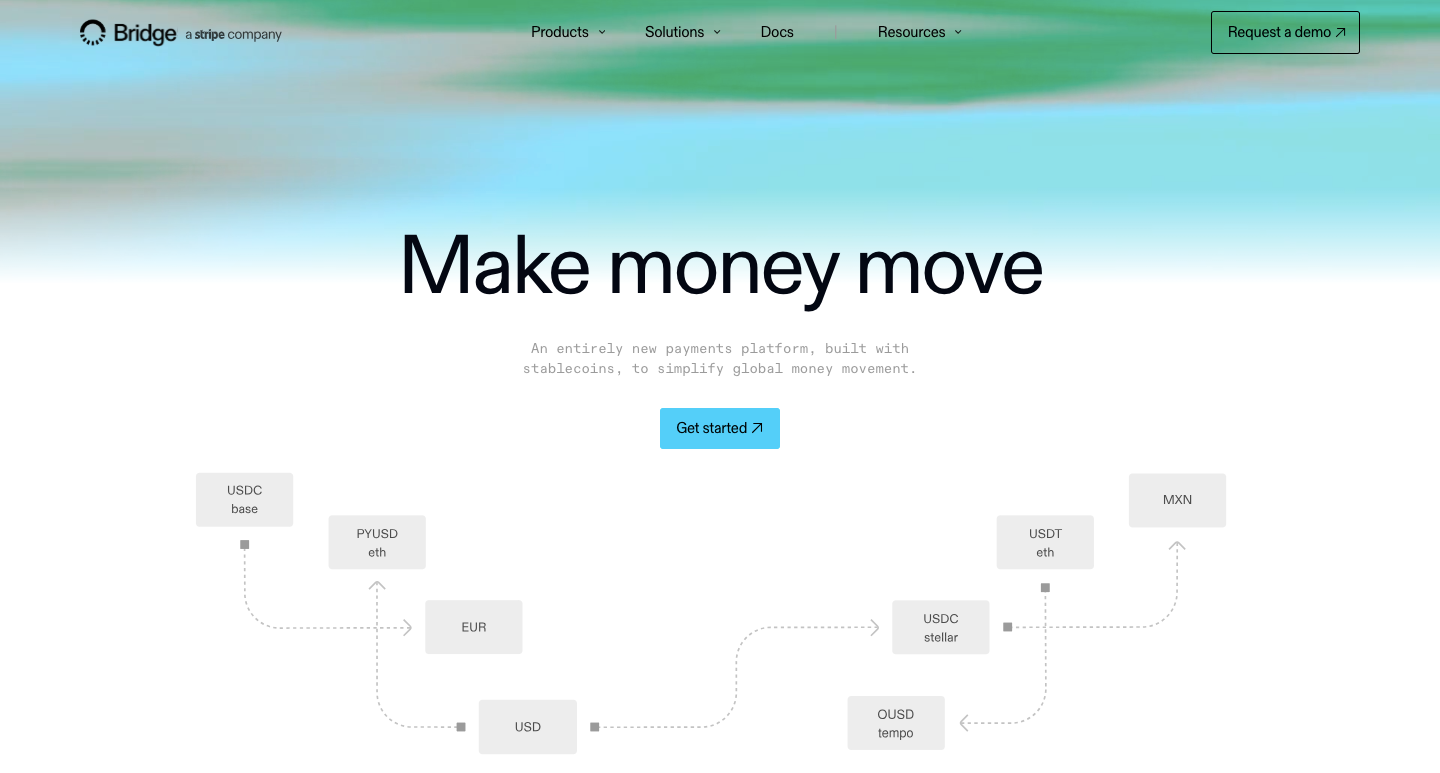
Bridge fits fintechs and platforms that want API-driven stablecoin accounts, conversion, payment acceptance, issuance, and global sending.
Bridge is an API-first option for teams that do not want to build every stablecoin payment component themselves. A Fireblocks directory entry describes Bridge as supporting business capabilities for accepting, storing, converting, issuing, and sending money globally.
Features: The cited directory lists fiat-to-stablecoin movement and support for DAI, USDC, and USDT. It also describes stablecoin account and payment functionality for embedded products.
Limitation: The public directory lists USD as the supported fiat currency. It says other currencies and assets may be available on request. Buyers should confirm exact fiat corridors, stablecoin networks, and operational responsibilities.
Best for: Product and engineering teams embedding stablecoin accounts, conversions, and payouts into a fintech or payments product.
A fintech could test a flow from a USD balance into USDC. Before production, it should validate the destination network, beneficiary screening, webhook events, reconciliation data, and fiat off-ramp.
3. BVNK
BVNK is strongest for businesses that need payment acceptance, stablecoin payouts, wallets, conversion, and fiat or crypto settlement in one stack.
BVNK documentation describes sending, receiving, storing, and converting funds across 130+ countries. The documented use cases include stablecoin and crypto payment acceptance, payouts, digital-asset wallets, and virtual accounts in USD, EUR, and GBP.
Features: Businesses can use BVNK for stablecoin payments, wallet operations, payouts, and payment settlement. Its API documentation also supports payment summaries and status updates for operational workflows.
Limitation: Payment flows require detailed compliance and party information. The documentation warns that incorrect currency or network choices can cause declines or potential loss. Buyers need strong exception-handling processes.
Best for: PSPs, marketplaces, merchants, and platforms needing managed B2B settlement and payout workflows.
A platform can preview a BVNK payment summary before creating a payout. It can then validate the beneficiary and network, use webhooks for status updates, and reconcile the transaction.
4. Circle
Circle is a strong fit for businesses that want issuer-led USDC infrastructure, wallets, custody, minting, redemption, and payment orchestration.
Circle’s product scope extends beyond a wallet API. Its stablecoin payments offering includes USDC wallets, custody, minting, redemption, blockchain interoperability, and payment orchestration.
Features: Circle describes Travel Rule handling, screening, and monitoring. Its product page states stablecoin settlement across 180+ countries. These capabilities can support USDC-based payouts, merchant settlement, marketplace payments, payroll, and account funding.
Limitation: Circle is centered on its stablecoin ecosystem. Buyers needing broad multi-issuer or multi-stablecoin orchestration should verify asset and corridor fit before selecting it.
Best for: Companies building USDC-native payouts, merchant settlement, B2B payments, marketplace payments, payroll, or account-funding flows.
A marketplace could evaluate a creator-payout flow in which customers fund an account. Funds would settle in USDC before recipients are paid across a supported country and network.
5. Fireblocks
Fireblocks suits enterprises and payment providers that need custody, wallet governance, payment orchestration, compliance controls, and network connectivity.
Fireblocks is designed for organisations that want greater control over their wallet and treasury operations. Its payment infrastructure includes stablecoin accounts, routing across chains and assets, and payment network connectivity.
Features: Fireblocks lists gas abstraction, KYT, Travel Rule and address screening, audit trails, MPC-secured keys, approvals, and role-based access. Its page states that the network connects 2,500+ participants in 100+ countries.
Limitation: Fireblocks states that it provides technology infrastructure only. Payment and financial services are delivered by partners under their own regulatory licenses. The stack may require more governance and implementation work than a managed payment provider.
Best for: Banks, PSPs, fintechs, and enterprises building self-managed treasury, custody, merchant settlement, or high-volume payout operations.
More control over wallets, policies, and routing can create more internal responsibility. Teams must manage configuration, approvals, counterparties, and daily operations.
An enterprise treasury team could configure MPC wallet policies, screen a destination address, route a stablecoin payout through a network partner, and retain an audit trail for reconciliation. It should also confirm which regulated partner provides each fiat leg.
6. Zero Hash
Zero Hash fits regulated fintechs and financial-services companies that want embedded fiat, crypto, and stablecoin conversion and settlement infrastructure.
Zero Hash is designed for companies that want to retain their own customer experience. Its APIs and SDKs can provide the underlying infrastructure for digital-asset conversion, custody, onramps, offramps, and settlement.
Features: Circle’s partner directory describes Zero Hash as supporting the sending, receiving, storing, and converting of fiat, crypto, and stablecoins. The listing also states that it integrates USDC and EURC across 10+ blockchains and provides an associated regulatory stack.
Limitation: Buyers must verify the Zero Hash entity, licenses, assets, chains, and payout corridors for the target customer flow. Broad platform positioning does not guarantee availability in every jurisdiction.
Best for: Fintechs, banks, and platforms embedding digital-asset conversion, custody, onramps, offramps, or stablecoin settlement.
A fintech can keep its own application interface while using provider APIs and SDKs for customer wallets, stablecoin conversion, transaction monitoring, and settlement. The exact regulated entity and service scope should be mapped to every origin and destination market.
7. Crossmint
Crossmint fits teams seeking a developer-friendly orchestration layer that combines wallets, payments, compliance, onramps, offramps, and multi-chain support.
Crossmint coordinates payments across blockchains, wallets, and business logic through one API. Its product is suited to teams building user-facing wallet and payment experiences alongside stablecoin infrastructure.
Features: The platform describes dashboards, widgets, REST APIs, webhooks, SDKs, and support for 50+ blockchains. This can help product teams prototype wallet flows and expand them across supported networks.
Limitation: Broad multi-chain coverage can increase integration and operational complexity. Buyers still need to validate local fiat payout availability, licensing responsibility, supported assets, and reconciliation for each corridor.
Best for: Consumer applications, marketplaces, and product teams that need wallet and payment orchestration alongside stablecoin infrastructure.
A product team can prototype a user wallet and stablecoin payment flow with REST endpoints, webhooks, SDKs, and a supported blockchain. It should confirm which parts of compliance, custody, fiat conversion, and local payout are handled by Crossmint or its partners.
How Fuze Business helps with faster global payments
Stablecoin rails can reduce dependency on slower, cutoff-driven payment workflows when the corridor, compliance checks, liquidity, and off-ramp are properly supported. The right solution depends on whether a business needs a managed platform, embedded APIs, issuer connectivity, or full custody and treasury control. To evaluate payment speed, total costs, settlement visibility, and operational efficiency across different corridors, see our guide to optimizing cross-border transactions.
Fuze Business is for sending, receiving, and converting funds through one platform. Its capabilities include difficult trade corridor access, banking network connectivity, enterprise-grade compliance, and faster settlement.
The intended advantage is speed: Fuze Business uses stablecoin rails rather than relying only on traditional payment workflows. However, the actual end-to-end timing depends on corridor availability, compliance review, liquidity, and local settlement conditions.
For finance and operations teams that want faster global payments without assembling a fragmented stablecoin stack, explore Fuze Business.