
Stablecoin rails are payment infrastructure that uses stablecoins and blockchain networks to move value between businesses, wallets, exchanges, payment providers, and bank accounts. A production integration normally includes a stablecoin asset, blockchain network, custody or wallet layer, on- and off-ramp, foreign-exchange conversion, compliance screening, payout banking, reconciliation, and operational monitoring.
Before starting, understand your payment corridors, currencies, counterparties, approval controls, settlement requirements, and legal or compliance obligations. Stablecoin settlement is not automatically cheaper or faster in every corridor. Fees, spreads, network conditions, conversion costs, compliance checks, and local banking access all affect the result.
Define stablecoin rails and map the payment flow
A stablecoin is a crypto-asset designed to maintain a stable value relative to a specified asset or basket. Its design, issuer, governance, redemption rights, and regulatory classification can differ by jurisdiction. FATF guidance provides useful context for understanding these arrangements.
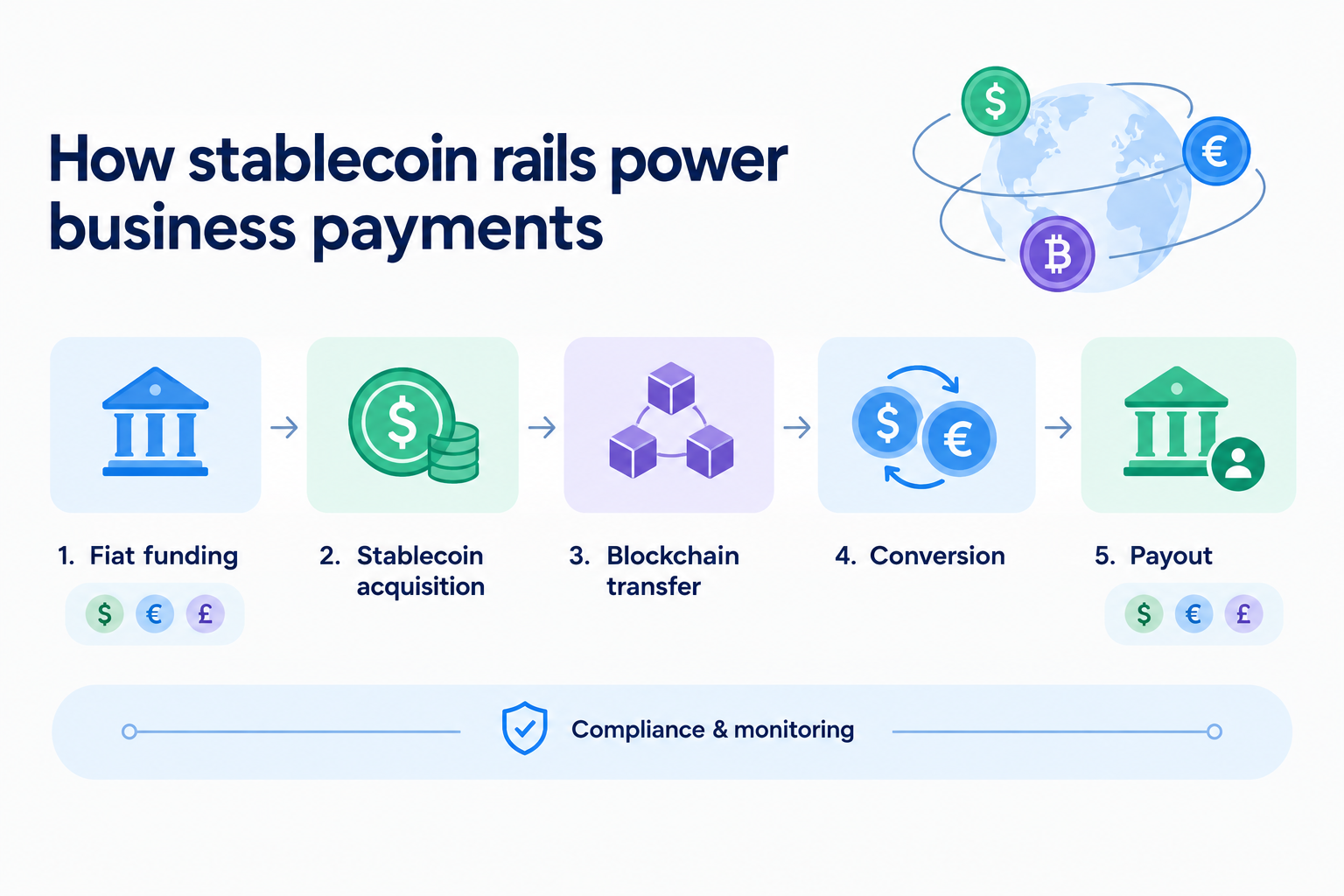
Stablecoin rails are the connected infrastructure that lets a business fund, transfer, convert, settle, and reconcile stablecoin-based payments. The rail is broader than the blockchain transfer. It can include the stablecoin issuer, blockchain network, wallet or custody provider, payment orchestration, compliance controls, foreign-exchange conversion, banking partners, and local payout rails.
Stablecoins are increasingly used for cross-border activity. However, IMF research on stablecoins indicates that much activity remains connected to crypto trading, arbitrage, and rebalancing rather than straightforward business payments.
Model a business payment as:
Fund → Screen → Convert → Transfer → Confirm → Convert or Redeem → Pay Out → Reconcile
The process may begin with payer funding in local currency or an existing stablecoin balance. It then moves through compliance checks, stablecoin conversion or selection, an on-chain transfer, recipient acceptance, conversion or redemption, and local-currency payout.
Separate settlement speed from end-to-end payment completion. An on-chain transfer may confirm quickly, while onboarding, screening, foreign-exchange conversion, or local payout may take longer. For a broader overview of payment methods, settlement processes, and the factors that affect international transfers, read our guide to cross-border payments.
Start with one supplier payment. Map the source currency, required payout currency, wallets, providers, blockchain, conversions, compliance decisions, and bank accounts. The flow is defined when every handoff has an owner and a recorded transaction identifier.
Choose the corridor and settlement model
Choose the corridor before choosing the rail. Define the payment purpose, source currency, recipient currency, transaction size, payment frequency, required settlement window, and counterparties.
Compare three operating models:
| Attribute | Correspondent banking | Stablecoin-first settlement | Hybrid settlement |
|---|---|---|---|
| Settlement layer | Banking networks | Blockchain network | Blockchain movement layer with banking payout |
| Funding source | Bank account or payment provider | Stablecoin or converted funds | Stablecoin, bank funds, or both |
| Recipient receives | Local or foreign fiat | Stablecoin, where accepted | Required local fiat |
| FX step | Bank or provider conversion | Before, during, or after transfer | Conversion before payout |
| Banking dependency | High | Still relevant for funding and payout | Relevant for local payout |
| Compliance checkpoints | Banking and provider controls | Wallet, asset, provider, and banking controls | Controls across both systems |
| Reconciliation method | Bank references and internal records | Transaction hash and internal records | Hash, payout reference, and ledger |
| Main failure mode | Delays or rejected bank transfers | Unsupported asset, network, or wallet | Conversion, payout, or reconciliation failure |
Stablecoin availability is concentrated in U.S.-dollar-linked assets. IMF analysis reports that U.S.-dollar stablecoins account for the dominant share of issuance, with USDT and USDC representing a large portion of the market.
Stablecoin rails can reduce dependence on traditional banking hours or correspondent-bank chains. The complete payment may still depend on local banking availability, compliance review, foreign-exchange liquidity, and payout partners. BIS analysis also highlights the importance of considering the wider financial system around digital settlement.
Treat these as separate decisions:
•Stablecoin and issuer
•Blockchain network
•Wallet or custody provider
•Counterparty acceptance
•Redemption access
•Jurisdictional permissions
•Funding and payout routes
Choose the rail that satisfies the corridor’s compliance, liquidity, payout, and reconciliation requirements. Do not select a rail only because it has fast blockchain confirmation.
Build a corridor scorecard for one recurring supplier payment. Approve the model only when it has an accepted asset, funding route, recipient route, documented FX quote, compliant payout path, and fallback procedure.
Design compliance and operational risk controls before going live
Compliance controls must cover both digital-asset activity and conventional payment activity. This includes onboarding, sanctions screening, transaction monitoring, travel-rule or equivalent data requirements, wallet screening, suspicious-activity escalation, recordkeeping, and local licensing or registration obligations.
FATF guidance for virtual assets identifies relevant risks around global reach, pseudonymity, unhosted wallets, peer-to-peer transfers, and rapid adoption. These risks should inform the design of your controls.
The business should also consider stablecoin-specific exposure. This can include issuer risk, redemption limits, network disruption, wallet compromise, unclear ownership, and blocked or misdirected transfers.
Create a control checklist:
•KYB or KYC completed
•Beneficiary verified
•Destination wallet screened
•Sanctions and risk rules passed
•Payment approved
•Transfer monitored
•Payout confirmed
•Ledger reconciled
Controls should cover on-chain and off-chain events. Depending on the risk profile, use wallet allow-listing or deny-listing, address ownership checks, approval thresholds, transaction holds, exception handling, and reconciliation between blockchain records and internal ledgers.
The FSB recommendations for global stablecoins also emphasize governance, operational resilience, cybersecurity, AML/CFT controls, data access, recovery planning, disclosures, redemption rights, and supervisory cooperation.
Assign clear responsibilities before launch. Define who approves a payment, who releases funds, who handles a flagged transaction, and how the business responds to a delayed, rejected, misdirected, or technically failed transfer.
Create a pass/fail matrix for one payment type. The integration is not ready if the team cannot identify the sender and beneficiary, screen the destination, pause a risky transaction, document the decision, and reconcile the final payout.
Integrate payment execution, conversion, and reconciliation
Separate each payment into observable states. This makes failures easier to identify and prevents an on-chain confirmation from being mistaken for completed settlement.
Use this implementation sequence:
1.Create the payment intent.
2.Lock or display the conversion quote.
3.Run compliance and approval controls.
4.Fund the payment.
5.Execute the transfer.
6.Confirm the blockchain transaction.
7.Convert or redeem the stablecoin.
8.Complete the local payout.
9.Reconcile the payment and ledger.
Store the business payment ID alongside the wallet address, blockchain transaction hash, asset, network, amount, exchange rate, fees, timestamps, compliance status, payout reference, and final accounting status.
Design for idempotency. A retry after a timeout or ambiguous confirmation must not create a duplicate payment. Use explicit states such as pending, confirmed, converted, paid out, failed, rejected, refunded, and under review.
Account for blockchain fragmentation and interoperability. Different stablecoins and networks may not be directly interchangeable. An unsupported transfer can create loss or recovery risk.
The transaction hash proves an on-chain transfer. It does not by itself prove that the supplier received the required fiat currency.
Fuze Business is a unified business platform for sending, receiving, and converting funds. Its listed capabilities include currency and stablecoin conversion, cross-border payments, stablecoin wallets, transaction monitoring, banking connectivity, and settlement through banking and stablecoin rails.
Test one payment end to end. The internal payment ID, blockchain transaction hash, conversion record, payout reference, and general-ledger entry should resolve to one payment with no unexplained balance difference.
Pilot the rail and optimize it against measured business outcomes
Pilot one corridor and one payment use case before expanding across currencies, counterparties, or jurisdictions. Use the existing payment method as the baseline.
Measure:
•End-to-end completion time
•On-chain confirmation time
•Foreign-exchange spread
•Network fee
•Provider fee
•On- and off-ramp cost
•Failure rate
•Manual-review rate
•Exception-resolution time
•Reconciliation breaks
•Recipient satisfaction
Compare stablecoin performance with the incumbent method using the same payment size, corridor, urgency, and recipient requirements. The goal is to measure the complete payment rather than only the blockchain transfer. For more ways to assess payment speed, total landed cost, settlement performance, and operational efficiency, see our guide to optimizing cross-border transactions.
Do not use gross blockchain transaction volume as a proxy for business-payment adoption. BIS research warns that transfer-level measures can classify trading, lending, arbitrage, liquidity provision, and other activity as payments.
Optimize one variable at a time. Possible variables include the asset, network, funding route, payout route, settlement timing, approval workflow, or provider.
Set rollback conditions before the pilot begins. These may include repeated failures, unexplained reconciliation differences, unexpected costs, compliance exceptions, or insufficient recipient liquidity.
Use a pilot scorecard with the baseline method, stablecoin method, median completion time, total landed cost, failure rate, manual touches, reconciliation breaks, compliance exceptions, and recipient outcome.
Run a controlled batch of recurring payments. Compare median end-to-end completion time and total landed cost against the incumbent route. Scale only when the pass criteria are agreed in advance and no compliance or reconciliation issue remains unresolved.
How Fuze Business helps with faster global payments
Stablecoin rails can shorten the movement layer of a cross-border payment. The practical result still depends on funding, compliance, conversion, liquidity, and local payout.
Fuze Business is a unified platform for sending, receiving, and converting funds across cross-border payment corridors. It supports stablecoin wallets, currency and stablecoin conversion, access to difficult trade corridors, enterprise-grade compliance, transaction monitoring, banking-network connectivity, and settlement through stablecoin rails.
A business can use stablecoin-held funds while paying a supplier in the supplier’s required currency, subject to corridor availability, compliance approval, liquidity, and payout capability. The payment path should include transaction tracking and reconciliation from initiation through final settlement.
This approach is relevant to finance managers, global trade companies, and supply-chain managers that manage supplier, partner, and cross-border transactions. Fuze Business can help make global payments faster and quicker by connecting banking and stablecoin rails across the payment flow.
Stablecoin rails can improve settlement speed, payment access, visibility, or cost for some business corridors. The outcome depends on the complete route, not only the blockchain confirmation.Start with one corridor, build the required controls, reconcile every handoff, and compare results against the existing payment method.
See how Fuze Business can help your company send, receive, convert, and settle cross-border payments using banking and stablecoin rails.