
Stablecoin rails are the payment infrastructure that moves value through stablecoins from funding to final payout. They combine a stablecoin, blockchain settlement, wallets or custody, liquidity, foreign-exchange conversion, compliance controls, and payment interfaces.
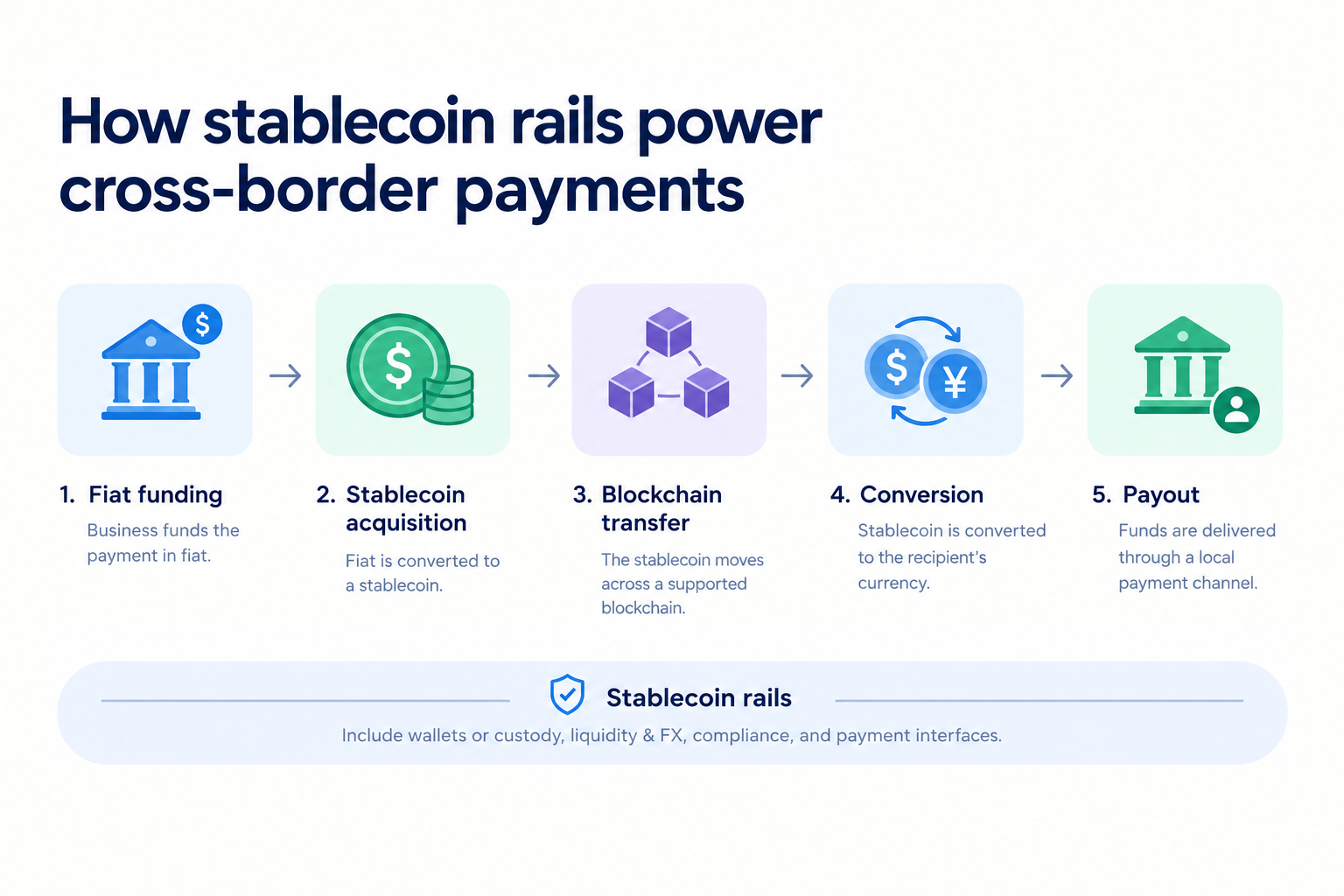
A simple flow looks like this: a business funds a payment in fiat, acquires a stablecoin, sends it across a supported blockchain, converts it into the recipient’s currency, and pays the recipient through a local financial channel.
This structure helps finance managers, global trade companies, and supply chain teams see where speed, cost, compliance, and operational risk enter the process. Stablecoin rails can reduce some correspondent-banking steps in certain corridors. However, results depend on regulation, liquidity, on- and off-ramps, blockchain conditions, and provider controls.
What stablecoin rails are and why businesses use them
A stablecoin is a crypto asset designed to maintain a stable value against a specified asset or basket. Most widely used stablecoins are denominated in U.S. dollars, but their designs, reserves, and redemption processes vary by issuer.
Stablecoin rails are broader than the token itself. They include the services and controls that move money between fiat accounts, wallets, businesses, and recipients. The blockchain transfer is only one layer of this arrangement.
The stablecoin transaction structure can include issuance or acquisition, custody, blockchain transfer, liquidity, foreign-exchange conversion, compliance screening, and fiat payout.
A business might use a stablecoin rail for a supplier payment, treasury transfer, remittance, or marketplace payout. The stablecoin acts as a digital settlement asset between the funding and payout points. For a broader overview of payment methods, settlement processes, and the factors that affect international transfers, read our guide to cross-border payments.
Stablecoins are used for crypto settlement and increasingly for cross-border payment activity. However, transaction data can overstate ordinary payments when complex smart-contract activity is counted as simple transfers. The BIS found that roughly one-third of studied stablecoin transactions in 2025 generated multiple steps. Nearly 60% of transfer events occurred within complex transactions, according to its analysis of stablecoin activity.
The core purpose is digital settlement between funding and payout points. A complete rail must therefore explain who funds the payment, which asset moves, how it is controlled, and how the recipient receives usable funds.
The main components of a stablecoin payment rail
A stablecoin payment rail connects traditional money to digital settlement. It must support both the sender’s funding process and the recipient’s payout process.
The main layers are:
| Layer | What it does | Failure or decision point |
|---|---|---|
| Fiat funding | Receives or reserves money from the payer | Bank access, funding timing, and payment instructions |
| Stablecoin acquisition | Converts fiat into the required settlement asset | Asset availability, issuer terms, and conversion price |
| Stablecoin layer | Represents the digital settlement asset | Issuer governance, reserves, redemption, and token rules |
| Blockchain settlement | Records and transmits the stablecoin | Network conditions, confirmation, and smart-contract execution |
| Wallet or custody | Controls who can hold, send, approve, and receive funds | Access rights, address controls, and recovery procedures |
| Liquidity and FX | Converts the asset into another stablecoin or fiat currency | Market depth, exchange rate, and conversion costs |
| Compliance and monitoring | Screens participants, wallets, and transactions | Regulatory coverage, alerts, investigations, and reporting |
| Fiat payout | Delivers the recipient’s required currency | Local payment access, payout timing, and reconciliation |
Funding and payout endpoints may use banks, payment providers, exchanges, or other regulated intermediaries. The exact structure depends on the provider and jurisdiction.
Institutional workflows can also include role-based approvals, transaction limits, and approved-address controls. These controls help separate the person who creates a payment from the person who approves it.
For example, a EUR-to-AED trade payment must answer five questions:
•Who funds the payment?
•Which stablecoin and blockchain are used?
•How is the transfer monitored?
•Where does conversion happen?
•How does AED reach the beneficiary?
A complete architecture diagram should show both the on-ramp and the off-ramp:
Fiat funding → stablecoin acquisition → blockchain settlement → liquidity or FX conversion → local payout
Stablecoin rail categories: custodial, non-custodial, and provider-managed models
Stablecoin rails differ mainly in who controls wallets, conversion, payout, compliance, and operational decisions. A FATF report on stablecoins highlights additional risks involving unhosted wallets, peer-to-peer transfers, and cross-chain activity.
| Model | Operating approach | Main consideration |
|---|---|---|
| Provider-managed | A platform or regulated intermediary manages wallets, conversion, payout, and often compliance | Simpler treasury operations, but greater dependence on provider coverage and controls |
| Peer-to-peer or non-custodial | Users transact directly from unhosted wallets | More direct movement, but greater responsibility for wallet, compliance, recovery, and counterparty risks |
| Single-chain | Payments use one blockchain | Simpler integration, but potentially narrower reach and liquidity |
| Multi-chain or interoperable | Payments use several blockchains or cross-chain systems | Broader reach, but more bridge, messaging, contract, liquidity, and monitoring complexity |
A provider-managed model may suit a finance team that wants one workflow for sending, receiving, converting, and tracking funds. A non-custodial model may offer more direct control, but it also places more responsibility on the business.
Single-chain rails can simplify technical and operational design. They may limit access when a recipient or liquidity provider uses another blockchain. Multi-chain rails can expand reach, but they introduce additional points for monitoring and failure.
Businesses should compare more than advertised blockchain speed. Important criteria include settlement time, supported currencies, corridor coverage, liquidity, compliance, operational control, integration effort, recovery options, and total cost.
How a stablecoin cross-border payment moves from sender to recipient
A stablecoin payment is complete only when the beneficiary receives usable funds and the sender has a matching settlement record. Blockchain confirmation alone does not complete the end-to-end payment.
1.Payment initiation: The payer provides the beneficiary, amount, currency, and transaction purpose.
2.Funding: Fiat funds are received or reserved, and the provider sources or converts the required stablecoin.
3.Compliance checks: Customer, beneficiary, wallet, transaction, and corridor checks occur before or during settlement.
4.Blockchain transfer: The stablecoin moves across the selected blockchain. Network confirmation and smart-contract execution affect timing.
5.Conversion: The recipient-side provider or liquidity venue converts the stablecoin into the requested currency, where required.
6.Payout and reconciliation: Funds reach the beneficiary, while the payment is recorded for treasury, accounting, and compliance purposes.
This process can reduce some correspondent-banking dependencies. It does not remove the need for liquidity, foreign-exchange conversion, local payout access, compliance, or reconciliation. The cross-border payment framework treats these surrounding functions as important parts of the arrangement.
A supply-chain payment should therefore be reconciled across three statuses:
•Blockchain status
•Payout status
•Accounting status
The payment passes operational review only when all three records match. A provider may show a confirmed blockchain transfer while the recipient still awaits currency conversion or local payout.
Stablecoin rail use cases and potential business benefits
Stablecoin rails can support several payment programs when the corridor has suitable liquidity, conversion access, regulatory coverage, and recipient access.
Common use cases include:
•Cross-border supplier payments before conversion and local payout
•Treasury transfers between supported markets
•Remittances where recipients can access local conversion or stablecoins
•Marketplace payouts to sellers or service providers
•Programmable settlement workflows for controlled business processes
Potential benefits include faster settlement, fewer payment handoffs, lower payment friction, greater competition, and broader access to digital finance. The BIS cross-border payments analysis and IMF materials emphasize that outcomes depend on the corridor and design.
Stablecoin activity across borders has also grown materially. IMF reporting estimates that gross flows in USDT and USDC increased from about $12 billion in the first quarter of 2020 to $316 billion in the first quarter of 2025, based on its financial market analysis.
These figures do not mean every payment is faster or cheaper. Programmable activity may combine transfers with trading, lending, liquidity, or settlement operations. The BIS found that complex transactions can make payment activity appear larger than simple payment use.
A global trade company should compare a traditional route with a stablecoin-enabled route using complete corridor data. Useful measures include end-to-end time, total fees, foreign-exchange spread, failed payments, manual interventions, and beneficiary receipt time.
The potential benefit is strongest when the complete route improves the business outcome. The blockchain transfer should not be evaluated separately from funding, conversion, payout, and compliance.
How stablecoin rails are secured, monitored, and regulated
Security is distributed across the token contract, blockchain, wallet or custody layer, access controls, liquidity providers, payout institutions, and compliance operations.
Faster settlement does not remove the need for controls. It makes pre-settlement screening and post-settlement monitoring more important.
Key controls can include:
•Risk-based customer due diligence
•Anti-money laundering and countering the financing of terrorism controls
•Sanctions and beneficiary screening
•Transaction monitoring and blockchain analytics
•Wallet and address risk checks
•Source-of-funds and transaction-purpose documentation
•Recordkeeping, reporting, and escalation procedures
The FATF guidance for virtual assets supports a risk-based approach. The exact obligations depend on the jurisdiction and the role of each participant.
Technical and governance controls may include allow-listing, deny-listing, freezing, burning, and withdrawal controls where appropriate. Their availability and use depend on the asset, issuer, provider, and applicable rules.
Businesses should also assess several risks:
•Stablecoin de-peg or redemption risk
•Issuer and reserve risk
•Smart-contract or blockchain outages
•Wallet compromise and unauthorized access
•Liquidity gaps and conversion delays
•Sanctions exposure and fraud
•Regulatory restrictions
•Reconciliation errors
Regulation differs across jurisdictions. The BIS notes that policy approaches are divergent, so businesses must assess each arrangement against local requirements and comparable risks.
A stablecoin rail is therefore a payment arrangement with multiple counterparties. It is not a risk-free substitute for banking infrastructure. A payment should stop or escalate when the beneficiary, wallet, corridor, asset, or transaction purpose does not meet the provider’s requirements.
How to evaluate whether stablecoin rails fit a payment program
Start with the payment corridor rather than the blockchain. Define the origin currency, destination currency, beneficiary access, local payout options, regulatory treatment, and available liquidity.
Then compare the complete route across operational, financial, and compliance measures:
•Corridor fit: Confirm currencies, beneficiary access, payout methods, and regulatory coverage.
•Total landed cost: Include funding, stablecoin acquisition, network fees, conversion spreads, provider charges, payout costs, compliance operations, and exception handling.
•End-to-end timing: Measure cutoffs, manual review, conversion, payout, reconciliation, and recovery from failed payments.
•Operational control: Review approvals, wallet permissions, address management, transaction limits, monitoring, reporting, and recovery.
•Continuity: Consider dependence on one stablecoin issuer, blockchain, liquidity venue, or payout provider.
•Fallback routes: Define how payments continue if the primary asset, network, provider, or corridor becomes unavailable.
A decision matrix can compare corridor fit, settlement time, total cost, liquidity, compliance, payout certainty, operational control, and fallback routes. For a practical framework to assess payment speed, total costs, settlement performance, and operational efficiency, see our guide to optimizing cross-border transactions.
A controlled pilot is a practical next step. Select one corridor, record baseline data from the existing route, and compare successful payout rate, median end-to-end time, total cost, exception rate, and reconciliation effort.
Expand the program only when the pilot meets predefined service, compliance, and treasury thresholds. Use stablecoin rails where the complete route improves the business outcome, not merely where the on-chain transfer is fast.
How Fuze Business helps with faster global payments
Stablecoin rails can connect funding, digital settlement, currency conversion, and local payout in one cross-border workflow. Results still depend on corridor coverage, liquidity, compliance, and provider access.
Fuze Business brings cross-border payments, faster settlement, stablecoin and currency conversion, banking network connectivity, difficult trade corridor access, and enterprise-grade compliance into one operating workflow.
It supports currencies including AED, USD, GBP, and EUR. By using stablecoin rails rather than relying only on traditional payment routes, Fuze Business is positioned to help businesses move money faster and with fewer payment handoffs.
For finance teams and global trade businesses that need to send, receive, convert, settle, and reconcile funds across borders, explore Fuze Business.