
Stablecoins are blockchain-based digital assets designed to maintain a stable value, commonly against a fiat currency. Stablecoin rails are the blockchain infrastructure used to issue, transfer, convert, and settle those assets.
2026 showed substantial stablecoin adoption. However, headline figures need careful interpretation. Crypto trading, exchange activity, bots, bridges, mints, burns, and internal transfers can inflate gross transaction totals.
The clearest enterprise takeaway is conditional. Stablecoin rails are becoming useful in selected cross-border and high-friction payment corridors. Adoption remains uneven, and compliance, liquidity, counterparty, and regulatory considerations still matter.
What stablecoin rails are and why adoption statistics need context
Stablecoin rails are the blockchain-based pathways that move stable-value assets between wallets, businesses, financial institutions, and payment providers.
Stablecoins are tokens issued on blockchain networks. Their design aims to maintain a stable value. Fiat-backed stablecoins typically rely on off-chain reserves intended to support the peg.
The rail is the infrastructure layer. The stablecoin is the digital asset moving across that layer. The wider system can include wallets, exchanges, payment providers, banking connections, conversion services, and compliance controls.
Public blockchains make transfers transparent and verifiable. However, a blockchain transfer is not automatically a commercial payment. A $100 million transfer between exchange-controlled wallets may increase gross on-chain volume without representing $100 million in goods, services, payroll, or supplier settlement.
Visa’s analytics methodology distinguishes total transaction activity from adjusted activity. Raw data can include bots, exchanges, smart contracts, bridges, mints, burns, and other non-payment flows.
The Bank for International Settlements identifies potentially faster and lower-cost cross-border transfers as a possible stablecoin benefit. It also notes that speed and cost are not guaranteed for every transaction or network condition. BIS research discusses these potential benefits and limitations.
Stablecoin market growth and transaction activity in 2026
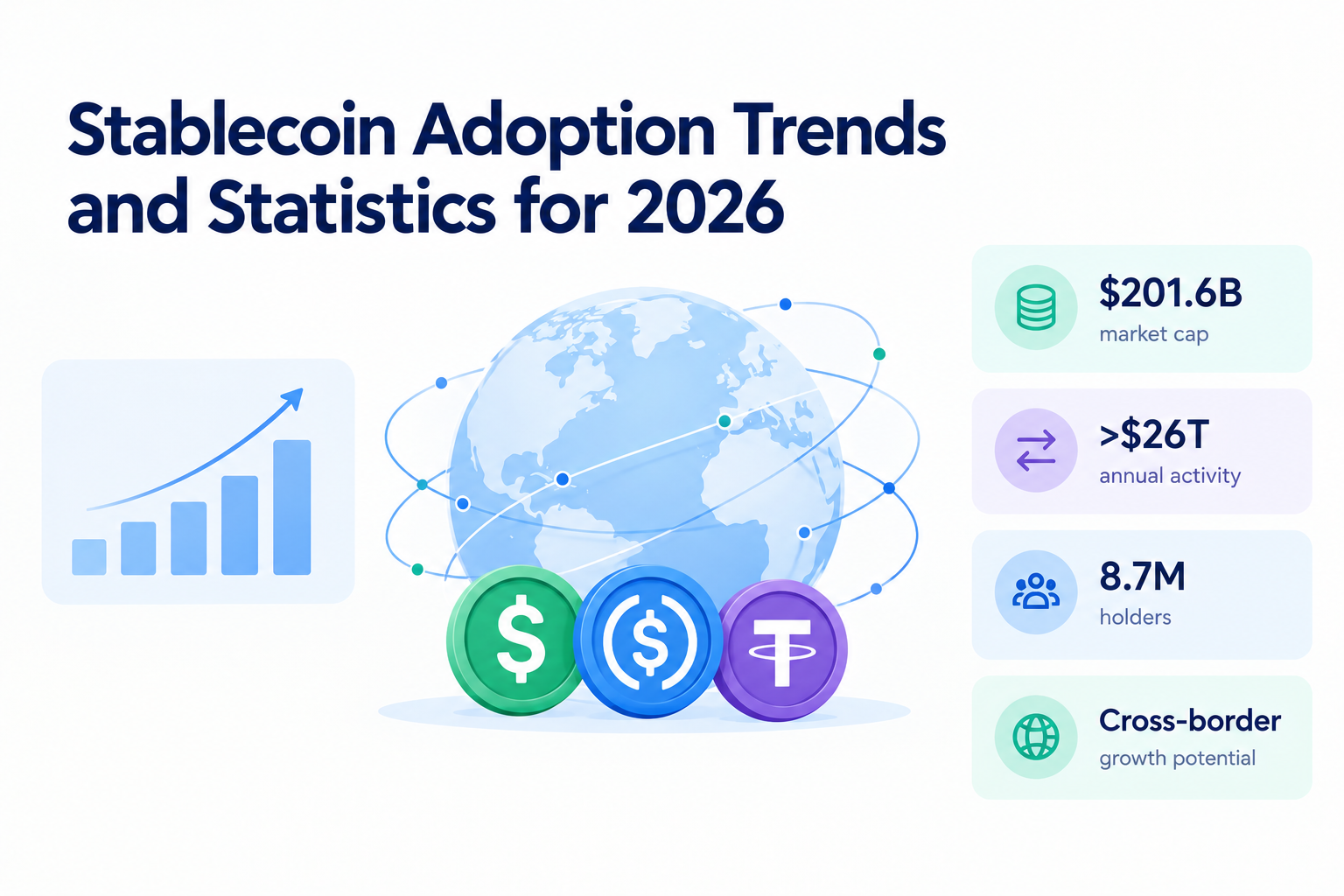
Stablecoin market capitalization reached approximately $201.6 billion for the top 20 stablecoins by the end of 2026. CoinGecko reported growth of approximately $73.5 billion during the year. CoinGecko’s 2026 report provides these market figures.
CoinGecko also reported approximately $161.2 billion in fiat-backed stablecoins as of August 2026. USDT, USDC, and DAI represented approximately 94% of that segment at the time.
The report counted approximately 8.7 million addresses holding stablecoins. USDT, USDC, and DAI accounted for approximately 97.1% of those holders.
These figures measure the size and distribution of the market. They do not show how often holders used stablecoins for commerce. Holders may use them for trading, liquidity, savings, collateral, or speculative positioning.
Separate 2026 industry analysis cited by PwC reported approximately $27.64 trillion in annual stablecoin transaction volume. This should be treated as gross or methodology-dependent on-chain volume, not direct evidence of payment adoption. PwC presents the reported industry transaction figure.
The comparison is important. Approximately $201.6 billion is a point-in-time market capitalization. Approximately $27.64 trillion is a reported annual flow. The figures measure different aspects of adoption and should not be directly equated.
Why stablecoin volume statistics vary so widely
Adoption statistics are only comparable when the reader knows what was counted and what was excluded.
Stablecoin supply is a point-in-time stock. Transaction volume is the value transferred during a period. Payment volume is the subset associated with an economic exchange.
Gross blockchain activity can include:
•Mints and burns
•Bridge locks and unlocks
•Exchange-internal rebalancing
•Smart-contract activity
•High-frequency bot or MEV loops
Allium describes these categories as activity that should be separated from genuine payment flows. Visa similarly states that public-blockchain stablecoin data contains substantial noise because users, bots, and smart contracts can move stablecoins manually or programmatically. Visa explains the difference between raw and adjusted activity.
An Allium summary of BCG and OCBC analyses reported approximately $26.1 trillion in unfiltered 2026 stablecoin transaction value. It reported approximately $5.5 trillion in 2026 adjusted volume under the Visa–Allium framework. These figures reflect different methodologies, not one industry consensus. The methodology comparison is outlined by Allium.
The European Systemic Risk Board reported that payment-linked proxies in Visa and Allium data grew from approximately $1.6 trillion in 2023 to approximately $2.4 trillion in 2026. It also noted that stablecoins represented a small share of global e-commerce transaction value in 2026. The ESRB discusses these payment-linked measures.
This creates several measurement layers:
•Supply
•Gross transfer volume
•Adjusted volume
•Payment-linked volume
•Active addresses
The 2026 figures are best presented as a range of measurement layers. Gross activity was in the mid-$20-trillion range under some methodologies. Adjusted activity was in the multi-trillion-dollar range. Payment-linked activity was below gross on-chain transfers.
Where stablecoin rails showed the clearest adoption signals in 2026
Stablecoin adoption remained closely connected to crypto-market activity. Common uses included trading pairs, exchange settlement, liquidity routing, and on- and off-ramping.
Stablecoins also supported use cases requiring continuous blockchain settlement. These included cross-border transfers, treasury movement, remittances, and selected business-to-business payment flows.
Stablecoin rails are most compelling where traditional payment paths are slow, fragmented, expensive, or difficult to access.
The BIS notes that stablecoins can transfer value directly between wallets without relying on banking hours or public holidays. The practical result still depends on network fees, liquidity, compliance processes, and the service provider. BIS outlines the cross-border payment potential.
Visa’s dashboard describes stablecoin networks as operating continuously. It also reports substantial weekend activity, supporting the idea that these rails can provide 24/7 settlement availability. Visa’s transaction dashboard shows this continuous activity.
Cross-border use is strategically important. Stablecoins can provide digital dollar or other fiat-linked settlement assets in markets with limited access to correspondent banking or foreign-currency accounts.
A global supplier payment could use a stablecoin rail for near-continuous settlement. The recipient could then convert the balance into local or operating currency through an approved payment platform.
This does not mean adoption is universal. Payment-linked activity remains smaller than total stablecoin transfer activity. For finance and supply-chain teams, the practical question is whether a specific corridor can settle faster with acceptable compliance controls. For a broader overview of international payment methods, settlement processes, and corridor considerations, read our guide to cross-border payments.
What the 2026 statistics do not prove about stablecoin adoption
Scale is evidence of market activity, not proof that every stablecoin transfer is a real-world payment.
A high stablecoin market capitalization does not prove that assets are used primarily for commerce. Holders may instead use them for trading, liquidity, savings, collateral, or speculative positioning.
A high transaction count does not prove a high number of independent users. Automated programs and repeated transfers can create many transactions.
A large gross transfer value does not prove that stablecoins have replaced correspondent banking, card networks, or other established payment systems.
Stablecoin use can also introduce risks involving issuer reserves, redemption, depegging, wallet security, fraud, sanctions screening, consumer protection, and regulatory compliance. BIS highlights related accountability and financial integrity concerns.
Different stablecoins represent claims on different issuers. They are not one interchangeable form of central-bank money. The BIS also discusses concerns involving monetary sovereignty and the structure of stablecoin liabilities.
The strongest 2026 conclusion is therefore conditional. Stablecoin rails achieved meaningful scale and demonstrated utility. Enterprise adoption still depends on specific corridors, counterparties, liquidity, compliance requirements, and integration quality.
An enterprise buyer should evaluate settlement time, supported currencies, corridor availability, compliance controls, conversion options, and reconciliation requirements. Global market-cap or volume rankings alone are not enough. For a practical framework to compare settlement speed, total payment costs, transaction visibility, and operational efficiency, see our guide to optimizing cross-border transactions.
How Fuze Business helps with faster global payments
Stablecoin rails reached significant scale in 2026. The most useful adoption signal is their role in specific cross-border corridors and settlement workflows. Raw transfer volume alone does not show the full business value.
Fuze Business is a unified platform for sending, receiving, and converting funds across global cross-border payment workflows.
Its capabilities include difficult trade corridors, cross-border payments, faster settlement, instant conversion of currencies and stablecoins, banking network access, and enterprise-grade compliance. Support includes AED, USD, GBP, EUR and more.
For finance managers, global trade companies, and supply-chain teams, Fuze Business uses stablecoin rails alongside payment and conversion capabilities to support faster global payment operations. Explore Fuze Business for faster global payments.