

Multi-currency receiving means accepting funds in multiple currencies, identifying the currency and payer, holding or converting the funds, and settling or routing them according to platform rules.
It is different from displaying localized prices. A platform should distinguish the customer-facing currency, payment acceptance currency, balance or holding currency, and payout or settlement currency. A customer might pay in EUR while the platform holds USD and pays a merchant in AED.
Before implementation, prepare a documented currency-and-rail matrix, a payment or banking provider, and a ledger that preserves original currency and amount. You also need webhook handling, reconciliation procedures, and a compliance review.
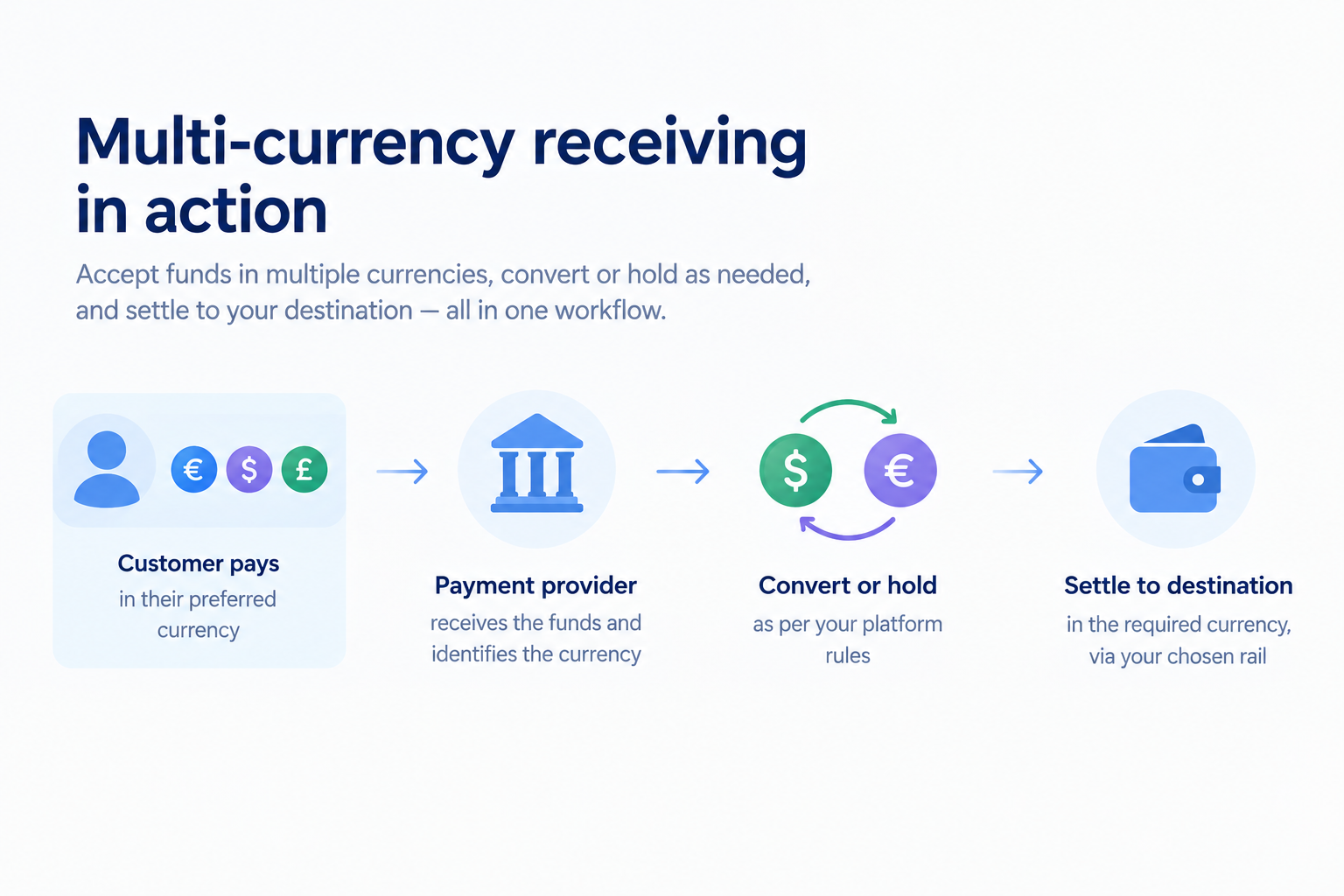
Define the currencies, rails, and receiving model before integrating
Start by deciding which currencies the platform can receive, hold, convert, refund, and settle. A multi-currency account may support holding, sending, receiving, and converting funds across currencies, sometimes with local account details attached to individual currency balances. Account models can vary by provider.
Receiving may use local account details, international correspondent or SWIFT connectivity, card balances, payment-provider balances, or a combination of rails. Availability depends on the provider, currency, customer location, and account eligibility. Receiving methods are provider-specific.
Separate the charge currency from the settlement currency. A payment may be accepted in one currency and converted before settlement. Supported payment currencies do not always define settlement behavior.
Document the following for every proposed currency:
| Currency | Receiving rail | Account or balance identifier | Can hold? | Can convert? | Settlement destination | Fees and timing | Compliance notes |
|---|---|---|---|---|---|---|---|
| USD | To be confirmed | To be confirmed | Yes or no | Yes or no | To be confirmed | To be confirmed | To be confirmed |
| EUR | To be confirmed | To be confirmed | Yes or no | Yes or no | To be confirmed | To be confirmed | To be confirmed |
| AED | To be confirmed | To be confirmed | Yes or no | Yes or no | To be confirmed | To be confirmed | To be confirmed |
| GBP | To be confirmed | To be confirmed | Yes or no | Yes or no | To be confirmed | To be confirmed | To be confirmed |
Include the payment rail, payer geography, beneficiary geography, minimum and maximum amounts, fees, expected settlement timing, refund behavior, and compliance restrictions.
If customers pay in a currency that the platform cannot hold or settle, define the conversion or rejection path before enabling that currency.
Fuze Business supports global payment workflows involving sending, receiving, and converting funds. Its capabilities include banking-network connectivity, currency and stablecoin conversion, and access to selected trade corridors. Supported currencies and settlement options depend on the business, jurisdiction, and payment route.
Checkpoint: Create a signed-off matrix for USD, EUR, AED, and GBP. Show whether each currency can be received, held, converted, refunded, and paid out. Every enabled currency should have a documented rail, balance destination, conversion rule, and exception path.
Configure eligible currency balances and receiving details
Set up account details or receiving credentials for each eligible currency and rail. A currency is not ready for production merely because it appears in a checkout or pricing interface.
A typical setup process is:
•Activate the business profile.
•Complete provider onboarding.
•Request or create each eligible currency balance.
•Obtain receiving details for each balance.
•Record provider identifiers.
•Document permitted use cases.
•Confirm the settlement destination.
Receiving details may include an International Bank Account Number (IBAN), sort code, account number, routing number, or international Bank Identifier Code (BIC). Providers can treat these as separate setup paths. Receiving details depend on the selected rail.
Eligibility may depend on the profile type, supported currency list, jurisdiction, and provider onboarding requirements. Account availability should be confirmed for the specific business profile.
Track each receiving destination as pending, active, restricted, or unavailable. Store the provider’s account or balance identifier with the internal customer, merchant, or platform record.
A EUR balance is not production-ready until its receiving identifier is active. A test credit must also map to the correct customer or merchant. The provider should confirm the expected settlement behavior.
Checkpoint: Each enabled currency must have an active receiving destination and a recorded provider status.
Design the payment and currency data flow
Build the payment object around the original transaction. At minimum, preserve the original amount, original currency, payer or merchant reference, receiving destination, provider transaction ID, fees, conversion rate or quote reference, and final credited amount.
A receiving event and a later payout, sweep, or conversion are separate money movements. Represent them as separate records in the platform’s data model. Provider documentation commonly exposes incoming-transfer events or resources that contain payment, sender, clearing, and receiving-account details. Use the provider transfer record as the authoritative transaction record.
For marketplace flows, map each incoming payment to the correct seller, merchant, order, invoice, or customer before releasing funds. A payment request or invoice creation should not mark funds as received.
Use explicit lifecycle states such as:
•Initiated
•Pending
•Credited
•Converted
•Held
•Refunded
•Paid out
•Failed
•Returned
•Under review
A practical flow is:
1.Create the payment intent or invoice.
2.Expose the correct receiving details.
3.Receive the provider event.
4.Retrieve the authoritative transfer record.
5.Validate the currency and beneficiary mapping.
6.Post the transaction to the ledger.
7.Apply conversion or payout rules.
Suggested fields include amount_minor, currency, source_reference, destination_id, provider_transfer_id, fee_amount, fx_rate, status, credited_at, and settled_at.
For example, a payer sends EUR to the EUR receiving details assigned to Merchant A. The system receives the credited event, retrieves the transfer record, matches the destination identifier to Merchant A, and posts EUR funds before any conversion. Transfer records can support this matching process.
Checkpoint: A test transfer must not be credited to the wrong merchant, duplicated, or silently converted without an auditable record.
Set conversion, holding, and settlement rules for each currency
Charge currency, holding currency, and settlement currency can differ. When they differ, the provider may convert funds before or during settlement. Payment and settlement currencies require separate decisions.
Choose whether the platform will:
•Hold the received currency.
•Convert immediately.
•Convert on a scheduled basis.
•Let the beneficiary choose where supported.
Choose the rule per currency and use case. A marketplace seller may require local-currency payout, while a global trade company may prefer to retain the invoice currency.
| Approach | FX exposure | Reconciliation complexity | Beneficiary choice | Operational effort | Refund handling |
|---|---|---|---|---|---|
| Hold original currency | Retains exposure to the original currency | Higher across multiple balances | More flexibility | Higher treasury effort | May simplify original-currency refunds |
| Convert at receipt | Reduces exposure after receipt | Requires conversion records | Less flexibility | More automated | Must record the rate and converted amount |
| Convert at payout | Delays the FX decision | Requires tracking until payout | Can support payout preferences | Requires scheduled controls | Must define the refund currency and rate |
Each conversion rule should define who bears fees, the rate source or quote used, the quote validity period, rounding behavior, residual amounts, refunds, chargebacks, and accounting treatment.
Settlement availability is not the same as payment acceptance or crediting. Funds may be credited but remain unavailable for payout because of provider, network, risk, or reserve rules. Balance availability can have separate conditions.
For a EUR receipt converted to USD, store the EUR amount, conversion information, fees, USD proceeds, timestamps, and linked provider references. Do not rely on a mutable exchange-rate display to reproduce the transaction.
Checkpoint: Finance should be able to reproduce the credited and settled amounts from stored transaction data.
Implement secure webhooks, idempotency, and currency-aware ledger posting
Use incoming-transfer events to identify credited funds, then retrieve the full transfer record using the event identifier. Incoming-transfer events can trigger transfer retrieval.
A webhook is a signal to inspect the transfer, not a substitute for the transfer record.
The handler should:
•Verify the signature or message authenticity.
•Deduplicate the event ID.
•Retrieve the authoritative transfer.
•Validate the destination and currency.
•Post the ledger entry.
•Enqueue the downstream action.
•Return success.
•Alert on exceptions.
Webhook endpoints should verify authenticity, acknowledge valid messages, tolerate retries, and process events idempotently. Reliable webhook handling requires verification and retry tolerance.
Use idempotency keys for supported API requests. They allow safe retries without unintentionally creating duplicate objects or repeating an operation. Idempotent requests help protect retryable operations.
Ledger postings should be immutable or adjustment-based. Retain the original currency and minor-unit amount. Link fees, conversions, refunds, returns, and payouts to the originating transfer.
Use provider transaction or transfer identifiers as stable reconciliation keys. Do not match transactions only by amount and date.
Checkpoint: Deliver the same credited event three times. The ledger should contain one credit, one provider reference, and one downstream payout instruction.
Test every enabled currency and reconcile funds before launch
Test each enabled currency in a relevant sandbox or controlled environment. Cover successful receipts, unsupported currencies, incorrect receiving details, duplicate notifications, unexpected amounts, failed transfers, returned funds, refunds, conversions, and payout failures.
Use both real-time webhooks and provider reports. Reconciliation should compare transaction references, statuses, amounts, fees, conversions, and payouts. Provider reports can verify whether webhook processing matches fund movements.
Do not treat “sent,” “credited,” and “settled” as synonyms. A transaction may move through states such as authorised, booked, failed, refused, or returned. Transaction lifecycle states should remain distinct.
Use a separate balance view for each currency. Show pending, available, reserved, converted, paid-out, returned, and unreconciled amounts.
| Test case | Expected provider state | Expected ledger entry | Expected balance movement | Alert condition |
|---|---|---|---|---|
| Successful receipt | Credited or booked | One original-currency credit | Available balance increases | Missing event |
| Duplicate event | No additional credit | No duplicate entry | No additional movement | Repeated processing |
| Failed transfer | Failed or refused | No final credit, or adjustment | No available increase | Unexpected credit |
| Returned transfer | Returned | Linked return entry | Balance decreases or reverses | Unmatched return |
| Conversion | Converted or settled | Original and conversion entries | Source decreases, destination increases | FX variance |
| Payout failure | Failed or returned | Reversal or pending adjustment | Funds remain or return | Payout mismatch |
| Refund | Refunded | Linked refund entry | Balance decreases | Refund without source |
Monitor for missing events, unmatched transfers, balance drift, unexpected foreign-exchange variance, duplicate processing, returned payments, and provider status changes.
Launch gate: Do not enable a currency in production until receipt, ledger posting, conversion, payout, refund or return, and reconciliation have passed in the relevant environment.
Checkpoint: Compare one provider report against the internal ledger for each enabled currency. Investigate every unmatched line before launch.
Apply jurisdiction, AML, sanctions, and data controls before going live
Multi-currency receiving can involve banks, payment institutions, money transmitters, marketplace operators, and other regulated or contractually restricted participants. Obligations depend on the business model and the jurisdictions involved.
Document the following before enabling a currency or corridor:
•Jurisdiction map.
•Provider permissions.
•Customer and merchant due diligence.
•Beneficial-owner checks where applicable.
•Sanctions screening.
•Prohibited-use policy.
•Transaction monitoring.
•Source-of-funds escalation.
•Record retention.
•Incident response ownership.
•Audit trail requirements.
The Financial Action Task Force states that virtual-asset service providers are subject to relevant anti-money laundering and counter-terrorist financing measures. It also supports a risk-based approach. Review FATF guidance for virtual-asset activities.
If stablecoins or other virtual assets are included, assess whether the platform or provider performs an activity that creates additional licensing, registration, screening, transaction-monitoring, travel-rule, custody, or reporting obligations. Stablecoin arrangements may require proportionate controls.
Enterprise-grade compliance is a listed Fuze Business capability. However, using a payment or banking platform does not remove the platform’s own legal or compliance responsibilities.
Before enabling a new currency or corridor, obtain documented approval covering provider availability, legal permissions, screening rules, settlement route, and escalation ownership.
Treat this as an implementation checklist, not a substitute for advice from qualified payments counsel in each operating jurisdiction.
Checkpoint: Every production currency and corridor should have an accountable business owner and written go-live approval.
How Fuze Business helps global payments
A reliable implementation starts with supported currencies and rails, active receiving destinations, accurate merchant or customer mapping, currency-aware ledger records, clear settlement rules, testing, reconciliation, and monitoring.
Fuze Business is a unified platform for sending, receiving, and converting funds across cross-border operations. Its listed capabilities include banking network connectivity, access to difficult trade corridors, AED, GBP, EUR, USD and more, stablecoin and currency conversion, enterprise-grade compliance, and faster settlement.
Once your currency matrix, ledger controls, and compliance checks are ready, evaluate Fuze Business for your global payment workflow.