
International wire transfer compliance is an operating framework for managing cross-border payments. It covers the business’s own duties and the controls performed by banks, money services businesses, payment institutions, and other providers in the payment chain.
The correct approach depends on the business’s role, the transaction type, the countries involved, and the provider’s licensing. Finance managers, global trade companies, and supply chain managers should verify corridor access, currency support, payment-data handling, screening, audit trails, exception processes, and compliance evidence.
The capabilities and compliance positioning attributed to Fuze Business in this article are supplied brand claims. They should be confirmed against current product, regulatory, and legal documentation before publication or procurement.
Define which compliance duties apply to the payment and the business
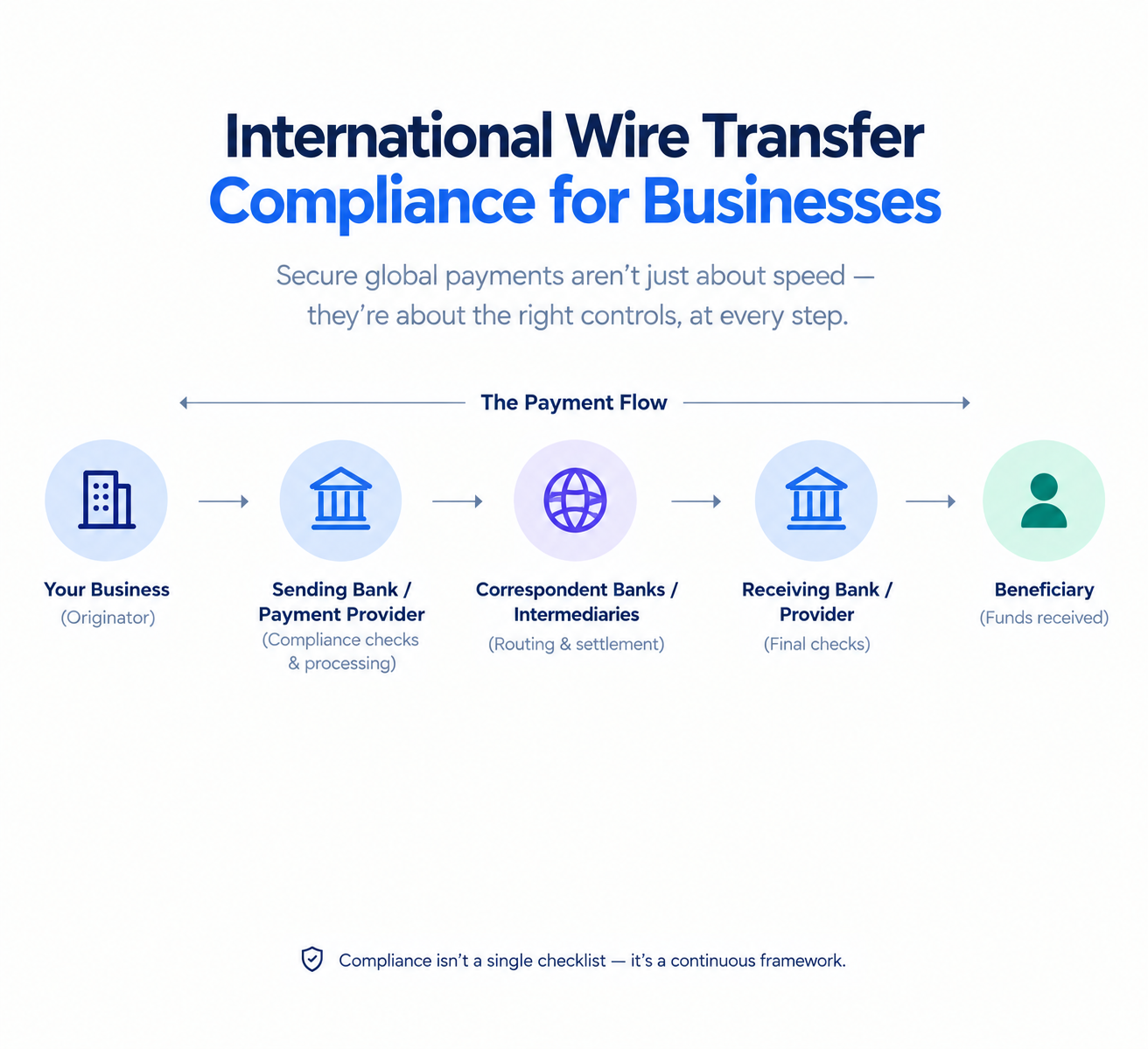
Compliance duties depend on the business’s role in the payment chain. A business may be the originator, beneficiary, intermediary, payment provider, bank, or money services business.
U.S. funds-transfer rules include recordkeeping and transmittal requirements for covered transfers. Under the cited Bank Secrecy Act and anti-money-laundering framework, these requirements can apply to payment orders of $3,000 or more. The applicable funds-transfer requirements should be assessed against the business’s role and transaction type.
The Travel Rule requires specified originator and recipient information to accompany covered transmittals. It does not replace transaction monitoring, sanctions screening, or suspicious-activity controls. FinCEN’s Travel Rule guidance explains how these requirements can apply.
International payments may also involve:
•Sanctions and anti-money-laundering requirements
•Customer due diligence and beneficial ownership checks
•Tax and foreign-exchange rules
•Data-protection obligations
•Local licensing and payment-services requirements
•Recordkeeping and reporting duties
A compliance program should document which party performs each control. It should also identify the responsibilities that remain with the business.
For example, a finance team should map one payment from payer onboarding through beneficiary receipt. The map should show where identity checks, sanctions screening, payment-data transmission, monitoring, approval, and record retention occur.
Build the core controls for KYC, sanctions screening, monitoring, and records
Customer due diligence (CDD), often called know your customer (KYC), should establish who the business and relevant counterparties are. It should also cover their activities, expected payment patterns, jurisdictions, products, and transaction purposes.
Sanctions screening must cover relevant parties, jurisdictions, and activities. The Office of Foreign Assets Control (OFAC) states that U.S. persons and other persons subject to its jurisdiction must avoid prohibited transactions involving sanctioned persons, blocked property, and prohibited jurisdictions or activities. These obligations also apply to digital-currency transactions. OFAC’s sanctions FAQ confirms that digital-currency payments are not exempt.
OFAC describes sanctions compliance as risk-based. The program should reflect the organization’s customers, products, services, geographies, transaction volume, and other risk factors. OFAC’s compliance guidance provides further context for tailoring controls.
A practical control sequence is:
1.Identify the customer, counterparty, and beneficial owners.
2.Screen relevant parties, jurisdictions, accounts, and payment details.
3.Approve the payment under documented authority limits.
4.Transmit the required originator and beneficiary information.
5.Monitor the transaction and related activity.
6.Reconcile settlement against the approved payment instruction.
7.Retain records and supporting evidence.
Payment records should preserve the originator, beneficiary, financial institutions, amount, date, payment instructions, and other required identifiers where applicable. Controls should also cover rejected, returned, amended, and manually repaired payments.
A provider-review test passes only when a sample transaction can be retrieved by customer or account reference. The record should contain enough payer, beneficiary, institution, amount, date, and purpose information to support an investigation.
Compare bank wires, payment providers, and stablecoin-enabled rails
Each payment rail creates a different control and operating model. The best choice depends on corridor complexity, settlement requirements, internal compliance capacity, and the evidence available to the finance team.
Traditional bank wires may provide established correspondent-bank processes and familiar documentation. Businesses should still assess intermediary-bank exposure, cutoff times, fees, foreign-exchange handling, rejected-payment procedures, and corridor availability.
Fintech and payment providers may centralize sending, receiving, conversion, reconciliation, and compliance workflows. The business must verify the provider’s licensing, regulated entities, program scope, safeguarding model, jurisdictions, and contractual allocation of responsibility.
Stablecoin-enabled rails may change the settlement path and reduce intermediary steps or settlement time. They do not eliminate sanctions, anti-money-laundering, customer-identification, monitoring, recordkeeping, or jurisdictional requirements. OFAC confirms that these obligations apply to digital currency as well as traditional fiat currency.
| Criterion | Traditional bank wires | Fintech or payment providers | Stablecoin-enabled rails |
|---|---|---|---|
| Compliance ownership | Bank and correspondent chain, with shared customer responsibilities | Regulated payment provider and banking partners, with shared customer responsibilities | Provider, banking or settlement partners, and the business |
| Supported corridors | Dependent on bank and correspondent relationships | Dependent on provider coverage and regulated entities | Dependent on provider coverage, settlement partners, and local requirements |
| Settlement model | Bank correspondent chain | Regulated payment-provider model | Stablecoin settlement path with conversion or off-ramp requirements |
| Speed | Affected by cutoffs, intermediaries, and local banking systems | May centralize processing and reduce operational steps | May support faster settlement, subject to conversion and compliance controls |
| Currency and stablecoin conversion | Usually handled through bank foreign-exchange services | May combine currency conversion with payment workflows | May provide currency and stablecoin conversion |
| Audit trail | Bank records, payment messages, and reconciliation data | Provider records, payment histories, and compliance evidence | Provider, wallet or account, conversion, and settlement records |
| Exception handling | Bank investigations, returns, recalls, and repair processes | Provider workflows for alerts, returns, refunds, and missing data | Provider workflows for screening, settlement, conversion, and returns |
| Internal operational burden | More coordination across banks and intermediaries | Potentially centralized operations, subject to provider evidence | Requires understanding of digital-asset, conversion, and settlement risks |
Select the rail that gives the finance team the clearest control evidence, not simply the lowest quoted fee. Before settlement, the provider should explain who screens the payer, beneficiary, wallet or account information where relevant, intermediary institutions, and destination jurisdiction. For additional ways to assess payment costs, settlement speed, and operational efficiency, explore our guide to optimizing cross-border transactions.
Operationalize approval, documentation, monitoring, and exception handling
A documented payment policy should define permissible corridors, currencies, counterparties, transaction purposes, approval thresholds, segregation of duties, and escalation paths.
The business should collect and retain commercial context when it is relevant to the risk assessment. This may include invoices, contracts, purchase orders, shipping documents, beneficiary details, and payment-purpose information.
Payment instructions should be reconciled against approved vendor or customer records. Changes to beneficiary details should require call-back verification or dual approval.
Monitoring should compare activity with the expected business profile. Relevant factors include amount, frequency, destination, origin, counterparties, and unusual routing patterns.
The business should define procedures for:
•Sanctions hits and potential false positives
•Missing originator or beneficiary information
•Suspicious activity
•Payment recalls and returns
•Provider outages
•Refunds and manually repaired payments
Record-retention periods depend on the jurisdiction and record type. U.S. Bank Secrecy Act materials commonly identify five-year periods for specified records, but the applicable requirement should be confirmed for each business and transaction type. The cited recordkeeping materials provide a framework for reviewing these obligations.
A quarterly control test should sample routine, high-value, new-counterparty, higher-risk-jurisdiction, returned, and manually repaired payments. Each sample should contain the required purpose, approval, screening, settlement, reconciliation, and exception evidence.
Evaluate a payment provider before onboarding it
Provider due diligence should establish the provider’s legal identity, regulatory status, jurisdictions served, compliance-program scope, permitted use cases, and role in the payment chain.
Confirm supported currencies and corridors against actual business needs. This should include any difficult trade corridors that materially affect operations.
Ask how the provider manages customer onboarding, beneficial ownership, sanctions screening, transaction monitoring, suspicious-activity escalation, Travel Rule or equivalent payment-data requirements, and record retrieval.
The onboarding review should also test:
•Rejected payments, sanctions alerts, and false positives
•Missing information, recalls, refunds, and account or wallet changes
•Settlement timing, conversion, fees, liquidity, and funding requirements
•Operational cutoffs, service levels, and business continuity
•Transaction histories, approval logs, screening outcomes, case references, and reconciliation data
When evaluating international payment workflows, review how currency conversion affects the total payment cost and the amount received.
The provider should identify which controls it performs, which banking partners perform, and which remain the customer’s responsibility. Regulatory assessment guidance can help structure this review.
The onboarding decision should fail if the provider cannot identify its regulated entities. It should also fail if the business cannot retrieve transaction records or investigate a payment flagged after submission.
Manage enforcement exposure and governance gaps
Noncompliance can result in blocked or rejected payments, investigations, remediation costs, operational disruption, contractual disputes, regulatory action, and civil or criminal consequences. The outcome depends on the applicable rule and facts.
OFAC publishes civil-penalty and enforcement information. These actions demonstrate that sanctions failures can create substantial financial exposure. OFAC’s enforcement information provides examples of published actions.
A compliance program should have accountable owners, written procedures, training, independent testing or review, issue tracking, management reporting, and documented remediation.
A provider’s statement that it is “compliant” is not a substitute for verification. The business should confirm the specific controls, licenses, jurisdictions, regulated entities, and responsibilities relevant to its use case.
Controls should be reassessed when the business adds countries, counterparties, currencies, products, payment rails, or materially different transaction volumes. Compliance is a control system, not a one-time provider check.
Governance is operating effectively when management can see open sanctions or payment-control issues. Each issue should have an owner, remediation deadline, and evidence of retesting after correction.
How Fuze Business helps with faster global payments
Faster global payments depend on both settlement speed and clear compliance controls. Businesses still need visibility into counterparties, payment data, screening, approvals, records, and exceptions.
Fuze Business is a unified platform for sending, receiving, and converting funds across borders. Supplied capabilities include cross-border payments, access to difficult trade corridors, AED, USD, EUR, GBP, and more, banking network connectivity, instant currency and stablecoin conversion, faster settlement, and enterprise-grade compliance.
Fuze Business can be faster than traditional payment approaches because it uses stablecoin rails rather than only traditional rails. This comparative performance claim requires current product and legal substantiation.
Explore Fuze Business to review how the platform may help eligible finance managers, global trade companies, and supply chain managers send, receive, and convert funds across borders with faster settlement and enterprise-grade compliance.