
This guide helps finance managers, global trade companies, and supply chain teams diagnose failed or delayed international payments. A failed international payment is one that is rejected, returned, blocked for review, or delayed beyond its expected settlement window.
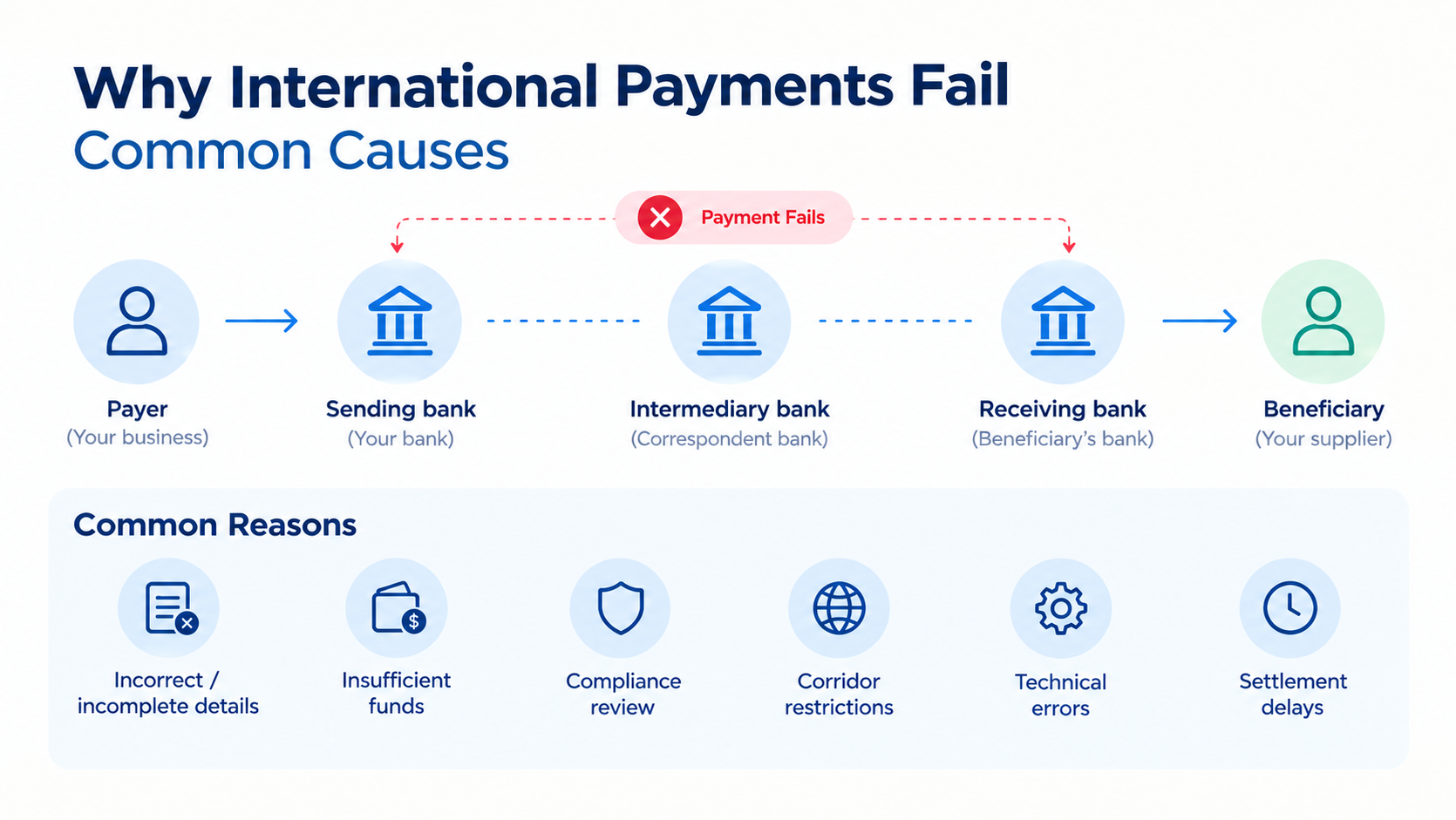
Cross-border payments can involve the payer, the payer’s bank, intermediary or correspondent banks, the beneficiary’s bank, and the beneficiary. They may also involve different messaging standards, compliance checks, currency conversions, operating hours, and settlement systems. Cross-border payment chains can therefore create several points where a payment may stop.
The correct remedy depends on the failure code, where the payment stopped, whether funds were returned, and the underlying issue. That issue may involve data, liquidity, compliance, infrastructure, or the chosen payment route. For an overview of payment methods, costs, and settlement considerations, read our guide to cross-border payments.
Identify where the international payment failed
Start by separating the payment message from settlement. A bank may send a payment message while settlement or the beneficiary’s account update remains pending. Payment messaging and settlement are related, but they are not the same process.
Cross-border payments can also slow down because of operating-hour differences, holidays, incompatible systems, fragmented messaging standards, and multiple compliance checks. The first diagnostic question is whether the payment was rejected, held, returned, or completed without being credited.
| Status | What it usually means | Immediate question |
|---|---|---|
| Rejected | The payment was refused before it could proceed | What rule or data field caused the rejection? |
| Pending | Processing has not finished | Which bank or system currently holds the payment? |
| Returned | The payment was sent back after processing or attempted delivery | Why was it returned, and when will the funds arrive? |
| Held for review | A compliance, fraud, or operational check is incomplete | What information or documents are required? |
| Beneficiary not credited | The payment may have settled, but the recipient has not received the funds | Has the beneficiary bank posted or located the payment? |
| Completed | The payment process shows as complete | Has the beneficiary confirmed receipt and the correct amount? |
Ask the bank or payment provider for the payment reference, failure or return code, rejection point, latest status-change date and time, and expected return timeline. A payment marked “sent” by the originating business but “pending compliance review” at an intermediary requires a different response from a payment returned because the beneficiary account is closed.
Check the six most common causes of failed international payments
Most failures fall into six categories. Use the visible symptom and immediate check to assign the right owner.
| Cause | Visible symptom | Likely owner | Immediate check | Prevention control |
|---|---|---|---|---|
| Data error | Rejected, returned, or sent for manual repair | Payments operations | Validate beneficiary details | Use verified beneficiary templates |
| Compliance review | Pending status or request for information | Compliance team | Provide transaction purpose and supporting documents | Maintain complete originator and beneficiary data |
| Liquidity or FX issue | Insufficient amount or failed conversion | Treasury | Confirm balances and currency | Check liquidity and conversion before release |
| Corridor restriction | Payment cannot be routed | Provider or bank | Confirm corridor availability | Maintain an approved corridor matrix |
| Technical or timing issue | Stalled or delayed processing | Operations | Check cutoffs, holidays, and system status | Monitor status and settlement windows |
| Account or bank restriction | Beneficiary cannot receive funds | Payments operations or beneficiary | Confirm account status and bank requirements | Independently verify account instructions |
Incorrect or incomplete beneficiary information can cause rejection, return, or manual repair. Relevant fields may include the account number, International Bank Account Number (IBAN) where applicable, routing code, bank identifier, legal name, address, currency, purpose, and invoice information.
Missing or unstructured originator and beneficiary information can also prevent correspondent banks from completing required screening and monitoring. Structured payment information helps banks process and review transactions more consistently.
Liquidity problems can stop a payment even when the beneficiary details are correct. The sending account may lack sufficient funds, the selected currency may be unsupported, or fees may reduce the amount available for settlement. A mismatch between the sending and receiving account currencies can also create a failed conversion.
Sanctions, anti-money-laundering, know-your-customer, fraud, and transaction-monitoring alerts may pause a payment. The bank may request the transaction purpose, invoice, contract, ownership information, or other supporting documents. Financial crime controls can therefore affect payment timing even when the transaction is legitimate.
Unsupported corridors, unavailable correspondent relationships, closed accounts, blocked accounts, and bank-specific restrictions can prevent delivery. Technical issues, message-format differences, cutoffs, holidays, and settlement schedules can create additional exceptions across the payment chain.
If a return message cites an invalid account number, correct the beneficiary data first. Obtain confirmation from the beneficiary through an independently verified channel before resubmitting.
Follow a step-by-step response when a payment fails
Do not send a duplicate payment until you know the original payment’s status. A duplicate may create an overpayment, reconciliation issue, or additional compliance review.
Use this response sequence:
1.Stop duplicate submission. Place the payment on hold until the original status is clear.
2.Capture the payment record. Save the reference, confirmation screen, amount, currency, value date, payment purpose, invoice number, and all bank or provider messages.
3.Confirm the debit status. Establish whether funds were debited, remain pending, or were returned.
4.Verify beneficiary information. Recheck the legal name, account number or IBAN, bank identifier, address, intermediary instructions, currency, and reference fields.
5.Identify the rejection point. Ask whether the payment is held for compliance review, awaiting an intermediary, rejected by the beneficiary bank, or returned.
6.Answer information requests securely. Provide requested documents through the bank’s secure channel. Do not send sensitive information to an unverified contact.
7.Confirm release or return. Ask when the payment will continue or when returned funds will reach the sending account.
8.Reconcile the outcome. Match the bank status with the beneficiary’s confirmation, invoice, bank statement, and internal ledger.
Banks and providers should be able to explain the payment’s current processing point and status code. Payment status transparency supports faster investigation and clearer ownership.
For repeated failures, escalate by corridor, beneficiary bank, currency, or payment type. Do not treat every failure as an isolated data-entry mistake. Record the owner, corridor, currency, bank chain, failure code, amount at risk, invoice due date, next update time, and fallback route.
An investigation is complete when the team can state where the payment stopped, why it stopped, whether funds remain in transit, who owns the next action, and when the next update is due.
Compare payment approaches before choosing a replacement route
Traditional correspondent banking can involve multiple institutions, sequential checks, currency conversion, and separate messaging and settlement processes. Cross-border payment technologies may reduce some of these friction points, but every route still has operating and compliance requirements.
| Approach | Best fit | Strengths | Trade-offs | Questions to ask before adoption |
|---|---|---|---|---|
| Traditional bank or correspondent chain | Established corridors and existing bank relationships | Familiar controls and broad institutional access | Multiple handoffs, less visibility, and possible delays | Which banks handle the payment, and how are exceptions tracked? |
| Specialist cross-border payment provider | Businesses seeking focused corridor and currency support | May simplify routing, FX conversion, and tracking | Coverage, licensing, compliance, and settlement vary | Is the required corridor available, and what happens during an exception? |
| Unified account with banking and stablecoin conversion capabilities | Businesses managing multiple payment and conversion needs | Combines account activity, conversion, and payment workflows | Requires assessment of supported assets, controls, and jurisdictions | Which currencies, corridors, compliance controls, and settlement methods are supported? |
| Internal multi-bank treasury process | Larger teams with established treasury operations | Control over bank selection and internal processes | Requires more staff, systems, monitoring, and reconciliation | Can the team maintain reliable visibility and fallback routes? |
Alternative providers and multicurrency systems may reduce routing or reconciliation friction. They remain subject to applicable compliance, licensing, corridor, and settlement constraints. No payment route removes the need for accurate beneficiary information, a lawful transaction purpose, sufficient funds, and appropriate review. Cross-border payment oversight remains relevant regardless of the provider.
Assess each route against corridor availability, supported currencies, settlement speed, FX conversion, total fees, compliance requirements, tracking, reconciliation, resilience, and fallback options. Prefer the route that meets the corridor and compliance requirements while reducing avoidable handoffs, unclear FX costs, manual reconciliation, and weak status visibility. Explore our global payments capabilities to understand how different payment workflows can support these requirements.
For a recurring supplier corridor, complete a documented review before moving material payment volume. Test the payment, confirm beneficiary receipt, review FX quote transparency, measure settlement timing, verify the compliance escalation path, and inspect the reconciliation output.
Build controls that prevent repeat payment failures
Prevention starts before payment release. Use standardized beneficiary onboarding and independent verification rather than relying on copied payment instructions from email alone.
Key controls should include:
•Verify beneficiaries independently and use dual approval for material changes.
•Maintain approved templates for recurring beneficiaries.
•Apply a controlled process for bank-account or ownership changes.
•Validate amount, currency, fees, value date, purpose code, invoice or purchase-order reference, and required payment data.
•Check sanctions and compliance information before release.
•Confirm balances, expected FX needs, and the approved conversion path.
•Check corridor eligibility, cutoffs, holidays, and beneficiary-bank requirements.
•Assign an owner for payment-status monitoring.
•Reconcile payments against bank statements, supplier confirmations, invoices, and the internal ledger.
•Review failures by cause, corridor, bank, currency, and value.
Businesses can also use a currency converter to review currency values when assessing conversion requirements.
A corridor matrix should show supported countries, currencies, beneficiary-bank requirements, cutoffs, holidays, required compliance documents, and fallback routes. Cross-border payment coordination can help teams structure these operating requirements.
Use payment metrics to identify recurring weaknesses. Useful measures include first-pass acceptance rate, return rate, information-request rate, average resolution time, percentage reconciled by the due date, and failure concentration by corridor.
Train payment staff on cross-border protocols and structured financial messaging. ISO 20022 migration can affect the quality and structure of payment data used across systems.
A control passes when a payment cannot be released until beneficiary, currency, compliance, approval, and reconciliation fields are complete. It should also have an accountable owner.
How Fuze Business helps streamline cross-border payments
Moving global payments efficiently requires accurate payment data, clear FX pricing, reliable settlement, strong compliance controls, and end-to-end transaction visibility. Addressing these factors can help businesses reduce avoidable payment delays, identify issues sooner, and simplify reconciliation.
Fuze Business brings sending, receiving, currency and stablecoin conversion, corridor access, compliance, and transaction tracking into a unified payment workflow. Through a single platform, businesses can manage payments and collections while accessing banking-network connectivity and support for difficult trade corridors.
The platform provides faster settlement, enterprise-grade compliance, transaction monitoring, and reconciliation among its capabilities. Businesses can view applicable FX rates and fees before confirming a payment, helping them make informed decisions about payment routes and costs. Actual availability and settlement times depend on the corridor, currencies, eligibility, and compliance requirements.
Explore Fuze Business to manage global payments through a more unified workflow for sending, receiving, converting, monitoring, and reconciling funds.