
Cross-border payment savings are a total-cost and workflow problem. The lowest advertised fee may not produce the lowest completed payment cost.
This guide is for finance managers, global trade companies, and supply-chain managers. It covers supplier payments, collections, partner payments, and treasury movements.
Before choosing a route, identify the origin and destination countries, currencies, amount, frequency, delivery window, and beneficiary requirements. Also confirm compliance documents and reconciliation needs.
Pricing, availability, eligibility, and settlement timing depend on the corridor and provider. The World Bank’s global remittance benchmark provides directional context only. Its latest homepage update reported an average cost of 6.36% on August 18, 2025, but business payments may differ from consumer remittances.
Map the full cost of each cross-border payment
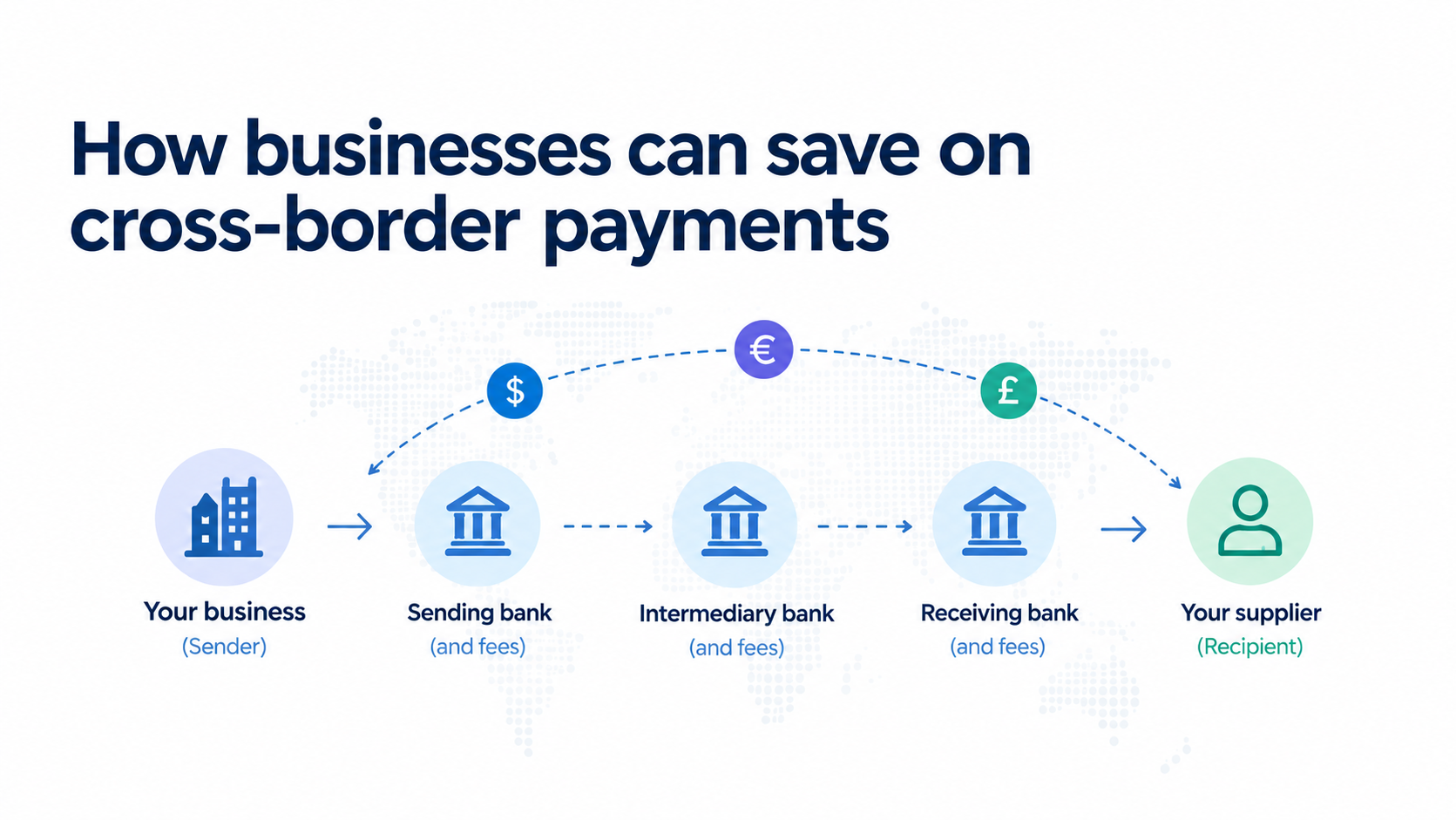
The full cost can include sender fees, recipient fees, intermediary charges, FX markups, conversion charges, account fees, network fees, and fiat withdrawal costs.
The FSB transparency target calls for providers to show total transaction cost. This includes sending and receiving fees, intermediary charges, FX rates, conversion charges, expected delivery time, payment status, and terms.
For a USD 10,000 supplier payment, the comparison is complete only when the team documents the amount debited, every known charge, the FX rate, the supplier’s received amount, and the expected settlement window.
Compare banks, payment providers, cards, wallets, and stablecoin-enabled routes
No payment rail is cheapest in every situation. The right choice depends on the corridor, currency, beneficiary, payment size, compliance requirements, and delivery window.
Correspondent banking can provide broad institutional reach. However, multiple intermediaries may create variable fees, processing times, and limited end-to-end visibility.
Non-bank payment providers may offer specialized corridors, alternative channels, and workflow tools. Review their licensing, supervision, corridor coverage, limits, and provider terms before approval.
Cards can suit purchases and customer payments. They may also involve FX conversion, cross-border, merchant, and transaction-limit costs.
Digital wallets and account-based providers can support local collections and payouts. Availability depends on the corridor, wallet type, and local rules.
Stablecoin-enabled routes may reduce settlement friction in selected corridors. Total cost can still include fiat conversion, trading, network, withdrawal, liquidity, and compliance costs.
A 2026 BIS working paper found bank FX markups ranging approximately from 2% to 4.7% in its sample, before explicit wire fees. It also found that stablecoins were not universally cheaper.
| Route | Best for | Main cost risk | Speed consideration | Corridor constraint | Decision question |
|---|---|---|---|---|---|
| Bank or correspondent network | Broad institutional reach | Intermediary and FX charges | May vary by route | Bank and corridor coverage | Is visibility sufficient for this payment? |
| Non-bank payment provider | Specialized corridors and workflows | Provider pricing and eligibility | May offer faster settlement | Licensing and supported routes | Does the provider support the full workflow? |
| Card network | Purchases and customer payments | FX, merchant, and transaction fees | Usually suited to immediate payments | Merchant and card acceptance | Does the payment size justify card costs? |
| Digital wallet or account-based provider | Local collections and payouts | Availability and withdrawal costs | Depends on local access | Wallet type and local rules | Can the beneficiary use the funds directly? |
| Stablecoin-enabled route | Selected digital settlement workflows | Conversion, liquidity, network, and compliance costs | May reduce some settlement friction | Asset, fiat, and regulatory access | What is the cost to usable beneficiary settlement? |
Choose the rail that minimizes delivered cost and operational risk for the specific corridor. Do not choose it only because it has the lowest headline fee.
A route is ready for selection only when it supports the required origin, destination, currency, beneficiary type, amount, compliance evidence, delivery window, and reconciliation reference.
Reduce FX and conversion costs before you send
FX cost may be embedded in the exchange rate instead of shown as a separate fee. Compare the provider’s effective rate with an independently observed reference rate at the same time.
The BIS analysis of cross-border payment costs identifies FX pricing, intermediary fees, liquidity, and access to fiat currencies as material cost drivers.
Converting funds more than once can add another spread or conversion charge. Document the source currency, receiving currency, conversion owner, and settlement currency for each workflow. Before approving a conversion, use a currency converter to compare the currencies involved in the payment.
Holding or receiving funds in a currency can change when conversion occurs. It also creates currency exposure and requires treasury controls.
For stablecoin-enabled workflows, compare the complete path from source fiat or stablecoin to the beneficiary’s usable settlement currency. Do not compare only the blockchain transfer cost.
Use this FX review before approval:
•Record the quoted rate and timestamp.
•Record the conversion amount and any separate conversion charge.
•Confirm the final settlement currency.
•Estimate the beneficiary’s expected amount.
•Assess exposure before holding currency balances.
•Avoid unnecessary re-conversion.
The review passes when the team can document the quoted rate, timestamp, conversion amount, final settlement currency, and expected beneficiary amount.
Lower avoidable fees through payment planning and consolidation
Payment frequency, transaction size, corridor, currency, and settlement speed can change the effective cost of a route.
Consolidating compatible payments may reduce repeated fixed charges. It is not a guaranteed saving because timing, liquidity, supplier terms, and compliance requirements may limit batching.
Separate recurring supplier payments, urgent payments, payroll or partner payouts, collections, and treasury conversions. The cheapest route may differ by use case. For more detail on planning international supplier transfers, read our guide to paying suppliers globally.
Do not pay for speed when the delivery window does not require it. Conversely, a cheaper route may become uneconomic if delays affect suppliers, production, or reconciliation.
Test payment planning in this order:
1.Segment payment types.
2.Group compatible payments.
3.Compare delivered cost.
4.Validate cut-offs and liquidity.
5.Approve the route.
6.Measure the actual received amount.
Batch only when the payment purpose, timing, currency, and compliance requirements are compatible.
A consolidation test passes when the batch has a documented purpose, clear beneficiaries, sufficient liquidity, approved timing, and lower measured delivered cost. It must also avoid supplier due-date breaches.
Incomplete beneficiary data, inconsistent purpose information, or missing documents can trigger manual checks, repairs, investigations, and delays.
Payment readiness should cover the corridor, counterparty, currency, cost, compliance, cut-off time, status tracking, settlement confirmation, and reconciliation reference.
FATF Recommendation 16 addresses payment transparency and information requirements. Exact documentation and screening requirements vary by jurisdiction, provider, corridor, payment type, and asset.
Swift guidance on payment data identifies incomplete or inconsistent information as a source of manual repair and reconciliation friction.
Failed, returned, delayed, or partially received payments can require resubmission, investigation, and supplier follow-up. They can also create additional reconciliation work.
Complete this release check before sending:
•Verify the beneficiary name and account details.
•Confirm the amount and currency.
•Add the payment purpose.
•Include the invoice or contract reference.
•Attach required compliance documents.
•Confirm fee allocation.
•Check the cut-off time.
•Record the tracking reference.
•Assign an exception owner.
A payment fails the release check if beneficiary data, purpose information, supporting documents, or the reconciliation reference is missing.
You know the payment is ready when another reviewer can reproduce why it was sent, which route was used, the expected cost, and the delivery expectation.
Measure realized savings after settlement
Compare quoted cost with realized cost after settlement. The final received amount, intermediary deductions, conversion outcome, and exception handling may differ from the initial estimate.
Track performance at the corridor level. A provider or rail may perform differently across currencies, destinations, payment sizes, and beneficiary types.
The FSB separates payment outcomes into cost, speed, access, and transparency. These dimensions can form a practical internal scorecard.
| KPI | What to measure |
|---|---|
| Effective delivered cost | Total cost compared with the amount received |
| FX variance | Quoted or reference rate compared with the applied rate |
| Average settlement time | Time from release to beneficiary settlement |
| On-time settlement rate | Payments settled within the approved window |
| Return rate | Payments returned or rejected |
| Manual review rate | Payments requiring manual intervention |
| Reconciliation completion rate | Payments matched to the accounting record |
Do not claim savings without a baseline period and comparable payment mix. Label internal pilot figures as hypothetical unless the business supplies verified results.
Compare routes monthly or after a material change in corridor, currency, provider pricing, compliance rules, or payment volume.
A route is ready to scale when it meets the approved cost ceiling, delivery window, compliance requirements, and reconciliation standard across a representative sample of completed payments.
Manage global payment workflows with Fuze Business
Fuze Business is a unified platform for sending, receiving, and converting funds across global payment workflows. Its capabilities include banking-network connectivity, access to difficult trade corridors, currency and stablecoin conversion, and enterprise-grade compliance.
Businesses can review applicable FX rates and fees before confirming a payment, helping them compare costs and evaluate suitable payment routes. Supported currencies, including AED, USD, EUR, GBP, etc, and select stablecoins, depend on corridor availability, business eligibility, counterparties, and compliance requirements. Settlement times and pricing also vary by use case, so faster settlement and better FX rates should be evaluated against actual results rather than treated as guaranteed outcomes.
Explore Fuze Business to assess its capabilities against your payment requirements, or read our global payments capabilities guide to learn how unified payment workflows can support your business.