
Finance, treasury, payments operations, global trade, and supply chain teams need a controlled process for overseas supplier payments. The right method depends on the supplier, payment corridor, currency, compliance requirements, and accounting workflow.
USDC is a USD-linked stablecoin issued by Circle. It is designed by its issuer to be redeemable 1:1 for U.S. dollars, subject to applicable terms and fees. However, prices on third-party platforms can trade above or below $1. Local-currency settlement also depends on the provider, corridor, beneficiary account, and applicable rules.
Before starting, confirm that you have:
•An approved supplier
•A commercial invoice or purchase order
•An agreed payment currency
•Verified bank or wallet instructions
•An internal approval policy
•A recordkeeping and reconciliation process
Review jurisdiction-specific tax, sanctions, foreign-exchange, import and export, and payment-service rules before execution.
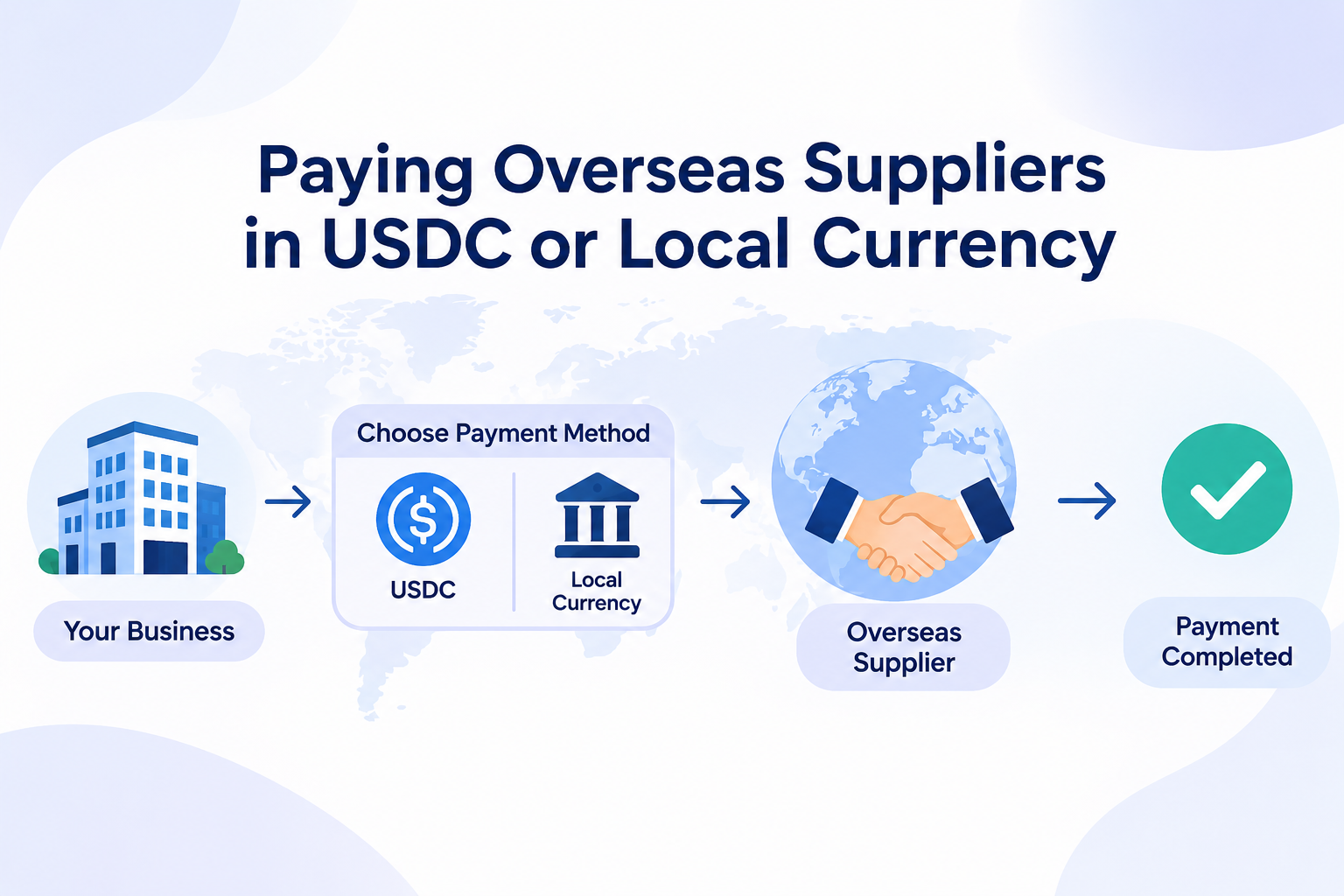
Choose USDC or local currency for the supplier payment
Choose USDC only when the supplier has explicitly agreed to receive it. Confirm that the supplier can securely control the wallet, use the selected blockchain network, and manage any conversion or redemption requirements.
Local currency is usually more suitable when the supplier needs funds in a domestic bank account. It can also avoid requiring the supplier to manage digital assets. The business should still confirm the exchange rate, fees, settlement route, and expected amount received.
Stablecoin payments can create additional considerations. These may include redemption, interoperability, fees, on- and off-ramps, sanctions, financial integrity, and local regulatory treatment. The BIS stablecoin considerations outline several cross-border payment issues.
| Payment choice | Best fit | Information required | Main control point |
|---|---|---|---|
| USDC | The supplier accepts USDC and can manage the wallet and network | Wallet address, blockchain network, amount, currency, and ownership or control confirmation | Verify the transaction route and sanctions controls |
| Local currency | The supplier needs settlement into a domestic bank account | Beneficiary bank details, supported corridor, exchange rate, fees, and expected settlement timing | Confirm the beneficiary and final amount received |
Fuze Business is for sending, receiving, and converting fiat currencies and stablecoins from one account. Explore Fuze Business when the payment workflow requires these capabilities.
For example, a supplier requesting payment in CNY should not receive USDC unless it has explicitly agreed to receive USDC. The supplier must also be able to manage the wallet and conversion process. This step is complete when the supplier’s written invoice or payment instruction clearly states the accepted currency and settlement method.
Collect and independently verify the supplier’s payment details
Collect the payment details from the approved invoice, purchase order, contract, and supplier record. Then confirm them through a trusted contact channel.
A USDC payment requires the correct beneficiary wallet address and blockchain network. Sending funds to an incompatible address or network can create recovery problems.
A local-currency payment requires information such as the supplier’s legal name, bank name, account or International Bank Account Number (IBAN) where applicable, country, currency, routing details, and payment-purpose information.
Check that the invoice, purchase order, contract, and payment request agree on:
•Supplier identity
•Invoice number
•Amount and currency
•Payment purpose
•Due date
•Goods or services
•Bank beneficiary details or wallet address
•Network, for USDC payments
•Requested value date
•Approver and confirmation evidence
Treat last-minute changes to bank or wallet details as a verification event. Do not process them as routine data entry. Independently confirm the change with a trusted supplier contact.
For a USDC payment, require documented network and wallet-address confirmation before release. For a local-currency payment, require a beneficiary-name and account-detail match before submission. Preserve the original instructions and approval evidence for later reconciliation. The IRS recordkeeping guidance supports retaining documents that substantiate business payments.
A second reviewer should be able to reproduce the payment instructions from the approved invoice and supplier record. That confirms this step worked.
Screen the supplier, transaction, and payment route before release
Do not release the payment until the beneficiary, destination, payment purpose, currency, route, and required screening checks are complete.
The Office of Foreign Assets Control (OFAC) states that U.S. sanctions obligations apply to transactions involving virtual currency as well as traditional fiat currency. Its guidance supports a risk-based sanctions compliance approach, including screening, internal controls, testing, training, and management commitment. OFAC’s virtual-currency guidance provides further detail.
FinCEN guidance explains that certain businesses accepting, transmitting, or exchanging convertible virtual currency may be subject to money-transmitter and Bank Secrecy Act obligations. The result depends on the activity and facts. Review the FinCEN guidance and applicable rules for the provider and transaction.
Distinguish your company’s purchase of goods or services from regulated activities that may apply to a payment intermediary or exchange provider. Obtain legal or compliance advice when the business model, provider, or corridor creates uncertainty.
The approval record should cover:
•Supplier identity and beneficial ownership where required
•Destination country and beneficiary location
•Goods or services being purchased
•Payment purpose
•Amount and currency
•Wallet or bank details
•Payment provider and route
•Screening results
•Exceptions to policy
•Approver and approval date
A payment fails this step if a beneficiary or destination creates a sanctions or compliance alert that has not been cleared under the company’s escalation process. The control is complete when the approval record shows who reviewed the supplier, route, amount, and exception status.
Fund the payment and convert into the agreed settlement currency
Fund the payment through the agreed rail. The business may start with fiat, USDC, or another supported balance, then convert or send through its payment provider.
Circle describes USDC as backed by highly liquid cash and cash-equivalent assets. It also describes redemption at 1:1 for U.S. dollars through eligible channels, subject to fees and eligibility conditions.
Evaluate the full delivered cost, not only the displayed exchange rate. The total may include:
•Funding costs
•Conversion spread
•Blockchain or network costs, where applicable
•Provider fees
•Bank fees
•Beneficiary-side conversion costs
For local-currency settlement, confirm the exchange rate, fees, expected destination amount, and expected settlement date. For USDC settlement, confirm the network cost and the supplier’s expected received amount.
Before approving a conversion, record the input amount, output amount, exchange rate, fees, timestamp, and expected beneficiary receipt. Compare the supplier’s required receipt with the displayed output after fees.
Fuze Business include sending, receiving, and converting fiat currencies and stablecoins from one account. It provides access to difficult trade corridors and cross-border payouts. Review Fuze Business for the supported workflow and corridor.
This step is complete when the approved payment instruction and transaction preview show the same source amount, destination amount, currency, fees, and beneficiary.
Send USDC or submit the local-currency payout
Release the payment only after the final details match the approved instruction.
For USDC, check the wallet address, blockchain network, amount, and internal approval immediately before release. For local currency, check the beneficiary bank details, destination currency, amount, and expected settlement route.
Blockchain transfers may be difficult or impossible to reverse after confirmation. Bank payments can also be delayed, rejected, or returned because of incorrect details, compliance review, or corridor restrictions.
Use dual approval for high-value or unusual payments. Preserve the final confirmation screen, transaction receipt, or payment reference. The operator should provide a reference that can be matched to the invoice and supplier record.
Notify the supplier of:
•Amount and currency
•Payment reference
•Expected receipt
•Expected settlement date
•Contact for payment issues
A USDC payment passes the operational check when its transaction hash or provider reference is recorded and the supplier confirms the expected amount. A local-currency payout passes when the provider marks it submitted or settled and the beneficiary details remain unchanged.
Reconcile the supplier payment and retain the supporting records
Match the payment to the invoice, approval, funding record, transfer, supplier receipt, and ledger entry. Reconciliation should explain any differences caused by fees, exchange rates, returns, or settlement timing.
IRS guidance recommends retaining documents identifying the payee, amount paid, proof of payment, date incurred, and description of the purchased goods or services. Review the IRS recordkeeping requirements.
For a USDC payment, retain:
•Invoice, purchase order, or contract
•Supplier approval and payment request
•Wallet address and blockchain network
•Transaction hash
•Source and destination amounts
•USD fair-market value or conversion evidence
•Fees
•Supplier confirmation
•Ledger entry and reconciliation
For a local-currency payment, retain:
•Invoice and approval
•Beneficiary details
•Source amount and currency
•Exchange rate and fees
•Destination amount and currency
•Payment reference
•Settlement date
•Return or exception status
•Supplier confirmation and ledger entry
IRS digital-asset guidance treats digital assets as property for federal income-tax purposes. It also states that taxpayers should maintain records sufficient to establish positions on federal tax returns. Review the IRS digital-asset guidance.
Ask the company’s tax adviser how its specific USDC acquisition, transfer, disposal, fees, and supplier expense should be recorded.
Use this reconciliation check:
•Invoice matched
•Beneficiary matched
•Payment reference captured
•Amount and currency matched
•Fees posted
•Foreign-exchange difference posted
•Supplier receipt confirmed
•Exceptions closed
Reconciliation fails if the ledger shows a supplier expense but the payment reference, destination amount, or supporting invoice cannot be located. It works when an independent reviewer can trace the transaction from invoice to approval, funding, transfer, supplier receipt, and ledger entry.
Use one workflow for USDC collection, conversion, and supplier payouts
The decision is not simply whether USDC is faster or cheaper. The supplier, corridor, compliance process, and accounting workflow must support the chosen settlement method.
A repeatable process should connect supplier onboarding, payment instructions, screening, approvals, funding, conversion, payout, and reconciliation. This reduces gaps between the payment decision and the audit trail.
Fuze Business is a cross-border payments platform for businesses to send, receive, and convert fiat currencies and stablecoins from one account. Its supplied capabilities include USDC collection, conversions between currencies and stablecoins, cross-border payouts, access to difficult trade corridors, and enterprise-grade compliance.
Explore Fuze Business to collect USDC, convert balances, and pay overseas suppliers in supported local currencies from one business account.